Christmas Light Power, Timers & Safety Planning Guide 2026
How to plan Christmas light power load, circuits, timers, and outdoor electrical safety for 2026 — avoid tripped breakers, overloaded cords, and hazards.
This article contains affiliate links. If you purchase through these links, we may earn a commission at no extra cost to you. Learn more.
| Light Type (100 lights) | Typical Draw | Notes |
|---|---|---|
| LED mini lights | ~2–5W | Roughly 10–20x more efficient than incandescent minis |
| Incandescent mini lights | ~40–50W | Classic small twinkle bulbs |
| LED C9-style bulbs | ~40–50W | Larger bulb, still efficient |
| Incandescent C9 bulbs | ~600–700W | Large traditional bulbs draw the most per string |
Two displays can look identical from the curb and behave completely differently once the sun goes down. One turns on every evening without a second thought — the timer clicks over, every zone lights up, and nothing ever trips. The other flickers, drops a section halfway through the season, or blows a breaker the first cold, damp night the whole yard runs at once. The difference almost never comes down to the lights themselves. It comes down to whether anyone did the electrical math before plugging everything in.
This guide is that math, laid out in plain terms: what a strand of lights actually draws, how to spread that load across circuits so nothing overloads, how to pick a timer that fits the display, how to route extension cords safely, and what outdoor electrical safety actually requires — GFCI protection, weatherproofing, and connections kept out of the weather. None of it is complicated, but little of it happens by instinct, which is why it belongs on the summer to-do list rather than the December one.
July is the right time for this work because there's no pressure. Outlets can be mapped in an afternoon, and a timer or a length of outdoor-rated cord can be ordered at off-season prices, with any gaps fixed before the display goes up rather than discovered while standing in the cold with a dead circuit. This guide is the electrical companion to the outdoor Christmas display planning guide — that guide covers zones, sequencing, and combining decoration types; this one covers what powers all of it safely.
How Much Power Do Your Lights Draw?
Every electrical device follows the same simple relationship: volts × amps = watts. A standard U.S. household circuit runs at 120 volts, and most residential circuits are rated for either 15 amps or 20 amps. Multiply those together and a 15-amp circuit tops out at 1,800 watts, a 20-amp circuit at 2,400 watts — but that's the absolute ceiling, not the number to plan against.
The number that matters is the continuous load rating, which is 80% of the circuit's maximum to leave headroom and avoid nuisance trips or overheating. That works out to roughly 1,440 watts on a 15-amp circuit and 1,920 watts on a 20-amp circuit. Anything a display runs for hours at a stretch — which describes essentially every Christmas light — counts as a continuous load, so this 80% figure, not the raw amperage rating, is the ceiling to budget against.
Finding the wattage of a given strand or device is usually straightforward: it's printed on the tag near the plug, on the box, or in the product listing, often alongside the amp draw. If only amps are listed, multiply by 120 to get watts. The one detail worth double-checking is whether a listing gives per-bulb draw or total strand draw — multiplying a small per-bulb number by a large bulb count is a common way displays get under-budgeted.
The biggest single factor in total wattage is whether a display runs LED or incandescent lights, and the gap between them is enormous. The figures below are typical, approximate values for common light types — actual draw varies by manufacturer and bulb size, so always check the specific product's label when precision matters.
The practical takeaway: a display built mostly on LED string lights can run several hundred lights on a fraction of the wattage that a much smaller incandescent display would use, which is what makes an ambitious, whole-house LED display fit comfortably within one or two circuits.
Budgeting the Load Across Circuits
Once individual wattage figures are known, the next step is adding them up per outlet and per circuit — and those are two different things. Multiple outdoor outlets frequently share one interior circuit, so the number that matters for the 1,440-watt ceiling is the circuit total, not any single outlet's total. The only reliable way to confirm which outlets share a circuit is to check the breaker panel labels or flip breakers one at a time and note which outlets go dark; guessing here is how displays end up unintentionally overloaded.
With that mapped, add up the wattage of everything plugged into each circuit: string lights, permanent lighting controllers, inflatables, projectors, and any spotlights. Keep the running total under roughly 1,440 watts on a 15-amp circuit, and treat that as a hard ceiling rather than a target to approach. Motorized items — inflatables with continuous-run blowers and projectors with fans — tend to draw disproportionately more than their size suggests, so they're worth weighing on their own rather than lumping in with a string of lights.
A worked example makes this concrete. Say a display plans for 300 feet of LED roofline lights (roughly 150–300W depending on density and color), two 100-light LED net-light bushes (under 10W combined), one mid-size inflatable (100–300W depending on the blower), and a projector (30–100W). Added together, that display sits comfortably under the 1,440-watt ceiling on a single 15-amp circuit — a realistic picture of how far LED efficiency stretches a modest budget. An equivalent incandescent roofline, at 600–700W per 100 C9 bulbs, would claim nearly half of that same circuit with its first 100 bulbs alone.
The count of lights driving this math shouldn't be a guess. The Christmas light calculator guide converts roofline footage and tree dimensions into an actual strand count, and that count is what should feed the wattage budget above — measure first, then add up watts, then assign circuits.
Timers & Smart Plugs
A display that has to be switched on by hand every evening gets used less consistently and is more likely to get left running all night. A timer solves that, and the choice among timer types comes down to how much control the display needs.
Mechanical timers use a rotating dial with pins to set on/off times — cheap and reliable for a simple display with one schedule, though they lack precision and any dusk-to-dawn adjustment. Digital timers add a programmable schedule and better time accuracy without needing an app or Wi-Fi. Smart/Wi-Fi timers and plugs go further: app-based scheduling, remote on/off from a phone, and often sunset/sunrise scheduling that turns lights on automatically at local sunset rather than at a fixed clock time — useful since sunset shifts through the season. Grouping several zones onto one smart plug keeps the display simple to control without wiring each strand to its own switch.
Permanent lighting systems sidestep this decision almost entirely — their control boxes bring app-based scheduling built in, so the best permanent outdoor Christmas lights roundup is worth a look for anyone who'd rather not manage a separate timer at all. For everything else, an outdoor light timer rated for exterior use and the display's full wattage handles the job. For specific smart-plug and mechanical-timer picks with verified pricing, see the smart outdoor plug and timer zone kit guide.
Extension Cords & Connections
The cord connecting a strand of lights to an outlet has its own load limit, separate from the circuit's, and an undersized cord is a real fire and overheating risk even on a circuit that isn't overloaded. Three factors interact: gauge (wire thickness, where a lower number means a thicker wire), length, and load. As a cord gets longer its effective capacity drops due to voltage loss over distance, so a light-duty cord that's fine at 25 feet may not be adequate at 100 feet for the same load.
As a rough guide, 16-gauge cords suit light loads over shorter runs (a strand or two of LED lights), 14-gauge steps up for moderate loads or longer runs, and 12-gauge is the choice for heavier loads — inflatables, projectors, or long cord runs — where a thinner cord would run warm under sustained draw. Every outdoor cord should also carry an outdoor rating, marked SJTW (or similar) on the jacket; an indoor-rated cord left outside is a genuine hazard regardless of gauge.
A few connection habits matter as much as the cord spec itself: avoid daisy-chaining more strands or cords end-to-end than the manufacturer's max-connection rating allows, never run a cord under a rug or bury it in mulch where heat can't dissipate, and keep the total load on any single cord run within its rating rather than treating it as a shared trunk line for the whole yard. For anything beyond a short single-strand run, outdoor extension cords rated for the display's length and load are worth having on hand before the install, not during it.
Outdoor Electrical Safety Essentials
A handful of safety basics separate a display that's merely bright from one that's actually safe to run unattended for weeks. GFCI protection is the most important: outdoor outlets should be GFCI-protected (either a GFCI outlet itself or a GFCI breaker), which cuts power instantly if it detects a ground fault — the kind of fault outdoor moisture makes far more likely than an indoor circuit ever sees. If an outdoor outlet isn't GFCI-protected, a portable GFCI adapter at the plug is a reasonable stopgap.
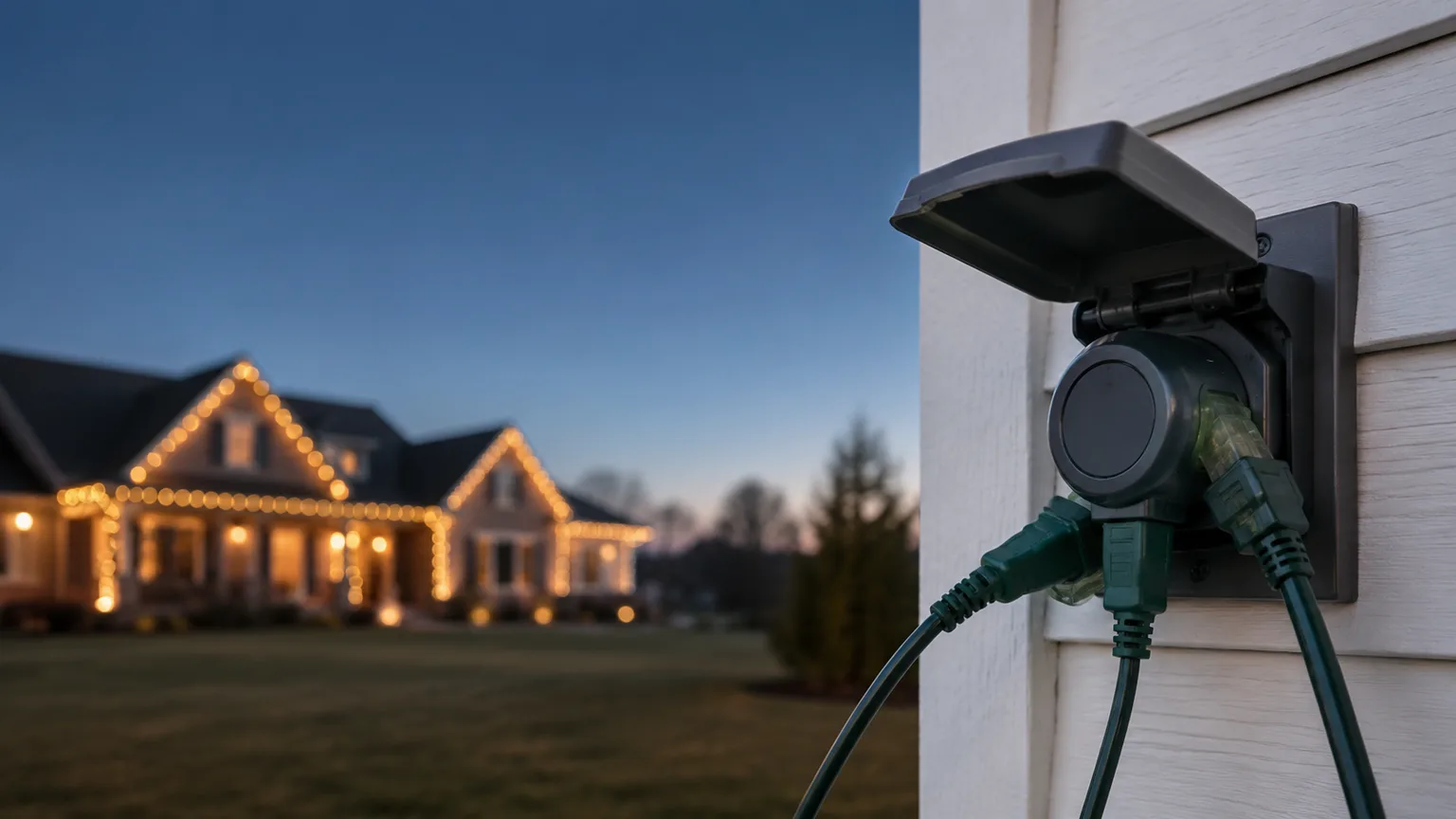
Every connection — where a cord meets a strand, where two cords join, where a plug meets an outlet — should stay up off the ground and away from anywhere water can pool; a junction sitting in wet grass is the single most common way outdoor electrical setups fail. Weatherproof, in-use outlet covers close over a plugged-in cord and keep rain and snow off the connection without requiring it to be unplugged, and a weatherproof outlet cover is a small, inexpensive fix for any exposed outdoor outlet.
Lights themselves carry an IP (Ingress Protection) rating — a two-digit code indicating resistance to dust and water — and anything mounted outdoors, especially where rain or snow can accumulate, should carry a rating appropriate for wet outdoor use rather than one meant only for covered or indoor spots. Before each season's install, inspect every strand and cord for cracked insulation, exposed wire, or a melted or discolored plug, and retire anything damaged rather than patching it with tape. The overarching rule underneath all of this: never overload a circuit or a cord past its rating — every other safety measure is a backstop, not a substitute, for staying within the load limits worked out earlier in this guide.
Weatherproofing & Winter Reliability
A display that's electrically sound in October can still fail in December if the connections aren't sealed against the season ahead. Every outdoor plug-to-plug junction benefits from a simple drip loop — letting the cord dip below the connection point before it rises back to the outlet — so any water running along the cord drips off at the low point instead of following the cord straight into the plug. Wrapping exposed connections in electrical tape or a dedicated weatherproof connector cover adds another layer, particularly for junctions that will sit through weeks of rain, snow, or freeze-thaw cycles.
Snow and ice add their own considerations: buried cords and connections are harder to inspect and more likely to sit in meltwater, and lights mounted where snow piles up should be rated for it. This is also where warm-weather installation pays off in a way that's easy to overlook — connections made and sealed in dry summer or early-autumn conditions bond and seat properly, while the same work rushed in freezing, wet December weather is far more likely to leave a gap that lets moisture in. A display wired and weatherproofed in warm weather is simply less likely to develop a mid-season fault than one thrown together in the cold.
Plan the Power in Summer
Everything in this guide is faster and cheaper to do now than in December. Walk the exterior of the house and map which outlets exist, which interior circuit each one is on, and roughly how much wattage the planned display will ask of each — that single afternoon of legwork is what prevents a tripped breaker three months from now. Order any timers, GFCI adapters, or outdoor-rated cords while they're in stock and priced for the off-season, rather than competing for picked-over inventory in November.
This guide is the power-and-safety half of a larger plan. For zone mapping, sequencing the install, and combining different decoration types into one coherent display, the outdoor Christmas display planning guide is the place to start, and for the hands-on technique chapters, how to hang Christmas lights on a roof and gutters covers the roofline, hanging lights on brick and stucco without nails covers masonry walls, and wrapping outdoor trees and columns covers trunks and railings. Do the electrical planning alongside that work now, and the display that goes up in autumn is one that just works, night after night, all season.
Last updated: July 2026. Prices and availability may vary on Amazon — check current details via the links above.
Frequently Asked Questions
How many strings of lights can I put on one outlet?
It depends on wattage, not string count. Add up the actual watts of everything plugged into the circuit that outlet belongs to (checking labels, since one outlet often shares a circuit with others) and keep the total under about 1,440 watts on a 15-amp circuit. LED strings draw so little that dozens can share a circuit comfortably, while a handful of large incandescent bulbs can approach that ceiling on their own.
Do I need a special outdoor timer?
Yes — any timer or smart plug used outdoors should carry an outdoor/weatherproof rating on its housing, distinct from an indoor timer. Beyond that, the choice is about features: a mechanical timer covers a single fixed schedule, a digital timer adds programmability, and a smart or Wi-Fi timer adds app control and often sunset/sunrise scheduling that adjusts automatically as sunset time shifts through the season.
Are LED lights actually cheaper to run than incandescent?
Substantially, yes. A typical string of 100 LED mini lights draws roughly 2–5 watts, compared to roughly 40–50 watts for the same count of incandescent mini bulbs — often a 10x-plus difference — and the gap widens further with larger C9-style bulbs. Beyond the electricity cost itself, that lower draw is what allows a much larger LED display to fit safely within a single circuit's continuous-load limit.
What gauge extension cord do I need for Christmas lights?
For a short run of LED string lights, a 16-gauge outdoor cord is typically adequate. Longer runs or heavier loads — inflatables, projectors, or several strands feeding through one cord — call for 14-gauge or 12-gauge, since thicker wire loses less capacity over distance and runs cooler under sustained draw. Always match the cord's rating to both the load and the run length, and confirm it's marked for outdoor use.
Do outdoor Christmas lights need GFCI protection?
Yes. Outdoor outlets should be GFCI-protected, either through a GFCI outlet or a GFCI circuit breaker, because ground faults are far more likely outdoors where moisture is a constant factor. If an existing outdoor outlet isn't GFCI-protected, a portable GFCI adapter plugged in at that outlet is a practical way to add the protection without rewiring.
Will my Christmas lights trip my breaker?
Only if the total continuous load on that circuit exceeds roughly 80% of its rated capacity — about 1,440 watts on a standard 15-amp circuit. Tripping usually means either too many devices sharing one circuit, an undersized extension cord overheating and faulting, or a genuine ground fault from moisture reaching a connection. Budgeting the wattage per circuit in advance, as outlined above, is what prevents this in the first place.
Can I run my whole display on one outdoor outlet?
Sometimes, but it depends entirely on the wattage total, not the number of items plugged in. A modest LED-based display can often stay within one circuit's continuous-load limit; a display that mixes in incandescent bulbs, inflatables, and projectors is more likely to need two or more circuits. Mapping which outdoor outlets share an indoor circuit, as described above, is the only reliable way to know for certain.
Get our Christmas gear picks
Holiday deal roundups and updates when our top picks change.
No spam, ever. Unsubscribe anytime.
Sources & Methodology
Methodology: ChristmasGearHQ guides are researched on an expert-verification model. Specifications, dimensions and capability claims are taken from the manufacturer's own published material and, where available, independent published reviews, and are attributed in the text to the source that published them. Where two sources disagree, we say so and name both rather than picking one. We do not make first-person hands-on testing claims.
Prices, sellers and availability are read from the live product page and move on their own schedule — confirm the current figure through the links above before buying. Edited by Nicholas Miles, Chief Editor. Corrections: contact us.
More Guides
- Christmas LightsBest Giant Lighted Outdoor Christmas Trees 2026: 6 to 20 Foot Cone, Flagpole, Spiral and 3D Picks
- Christmas LightsJellyfish vs Trimlight vs Gemstone - What Permanent Christmas Lights Cost in 2026
- Christmas LightsBest Smart Outdoor Plugs & Timer Zone Kits for Christmas Lights 2026
- Christmas LightsChristmas Light Power, Mounting & Cable Accessories 2026