Best Permanent Outdoor Christmas Lights 2026
This article contains affiliate links. If you purchase through these links, we may earn a commission at no extra cost to you. Learn more.
The short answer
The best permanent outdoor Christmas lights in 2026 for most homes are the Govee Permanent Outdoor Lights Pro (~$439.99): 100 feet of IP67 nodes with native Matter support, so Apple Home, Alexa, Google Home and SmartThings all drive the same roofline without a bridge, and 60 independently addressable RGBIC nodes that let a gradient or a chase travel along the eave instead of flashing one flat color. On Alexa or Google alone, the Govee Permanent Outdoor Lights 2 does nearly all of it for $279.99 (checked 17 August 2026). At ~$48.00, the KISUFU is the low-risk way to find out whether you'll use any of it.
Quick picks from this guide
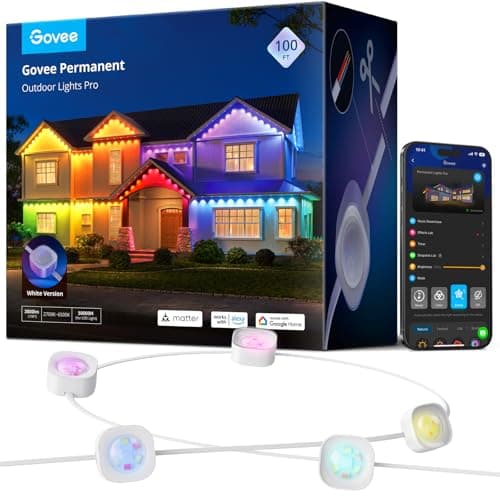
Govee Permanent Outdoor Lights Pro
Matter support is the reason this one sits at the top.
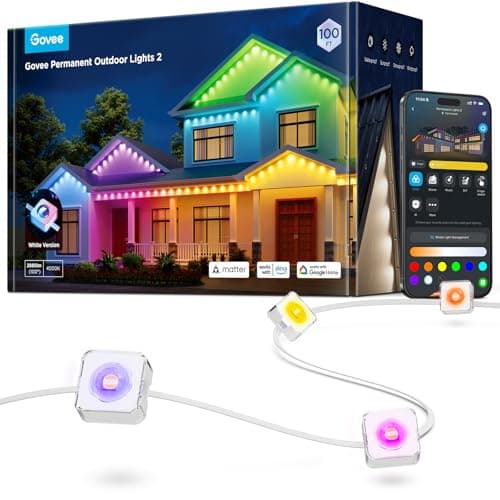
Govee Permanent Outdoor Lights 2
It undercut the Pro by $160 on 17 August 2026, and the gap has been as narrow as $110 at other prices we have recorded — but whatever the n…
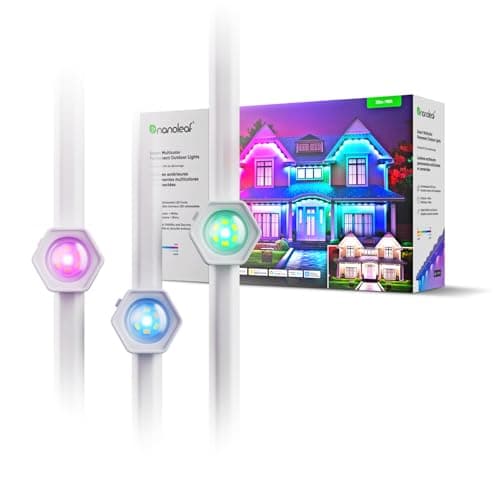
Nanoleaf Matter Permanent Outdoor Lights
The white channel is the spec that decides this one.
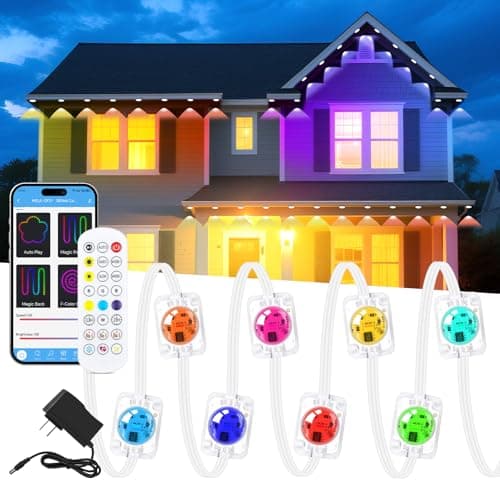
KISUFU 200FT RGB+IC Permanent Outdoor Lights
$48.00 buys 200 feet — twice the run of the $439.99 flagship for about a ninth of the money.
| Model | Price | Length | Smart Platform | IP Rating | Best For |
|---|---|---|---|---|---|
| Govee Permanent Outdoor Lights Pro | ~$439.99 | 100ft | Alexa/Google/Matter | IP67 | Best Overall / Smart Integration |
| Govee Permanent Outdoor Lights 2 | $279.99 | 100ft | Alexa/Google | IP67 | Best Value Premium |
| Nanoleaf Matter Permanent Outdoor Lights | ~$349.99 | 98ft | Matter/Alexa/Google | IP67 | Apple / Matter Homes |
| KISUFU 200FT RGB+IC Permanent Outdoor Lights | ~$48.00 | 200ft | App & Remote | IP68 | Best Budget |
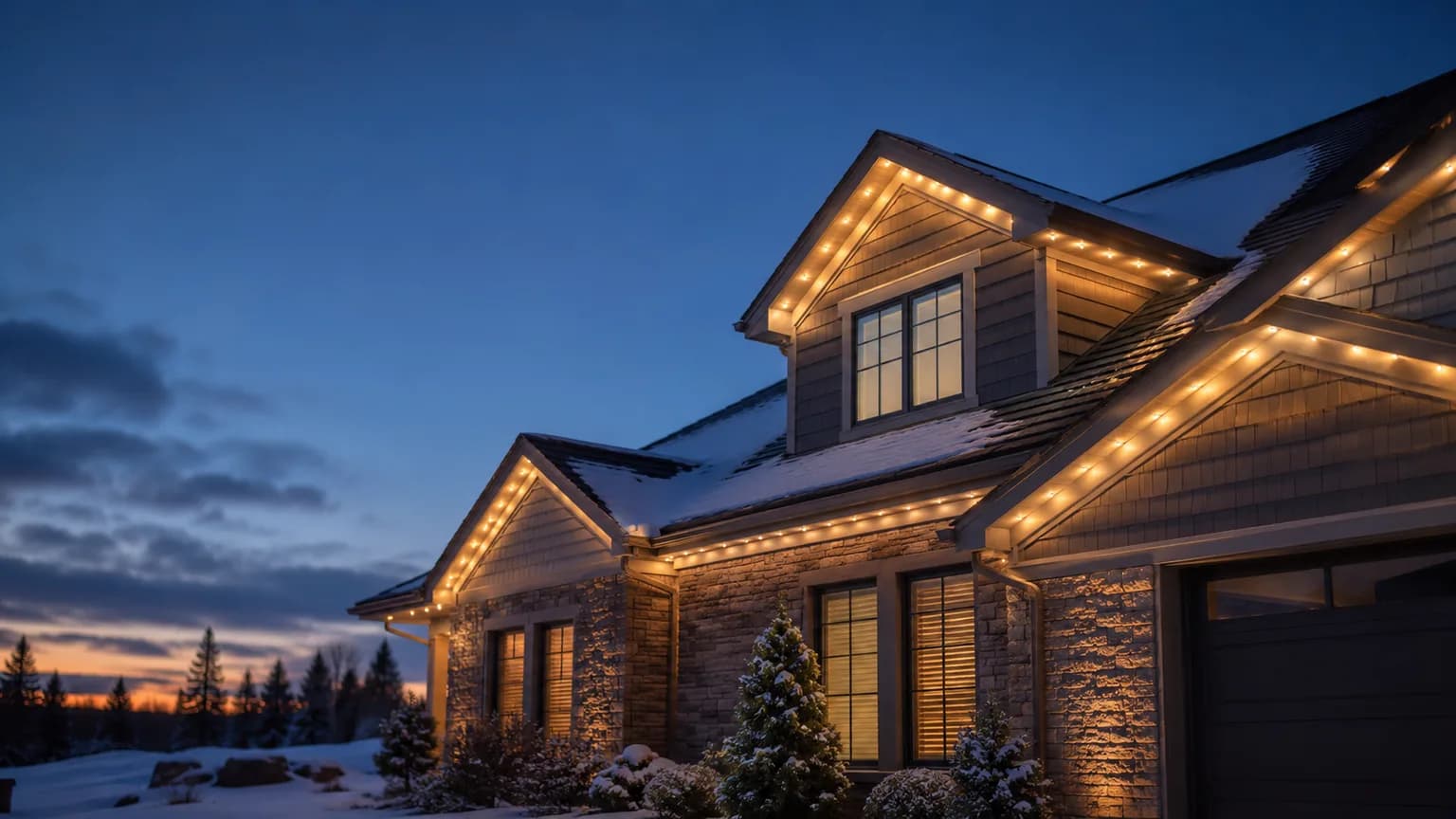
Instead of climbing a ladder every November, you mount weatherproof LED nodes along the roofline once. After that, colors, scenes and patterns change from a phone — any holiday, any game day, all year long.
This guide covers the best options for 2026, from the Matter-ready Govee Pro flagship down to a capable budget RGBIC pick under $60.
Weighing the two big names head-to-head? See Govee vs Nanoleaf permanent outdoor lights. Still deciding whether a permanent system beats seasonal string lights at all? Start with are permanent Christmas lights worth it. And if the flagship prices are the sticking point, the under-$100 tier now has real options — see the best budget permanent outdoor lights.
Our Top Picks
1. Govee Permanent Outdoor Lights Pro — Best Overall / Best Smart Integration
Price: ~$439.99 Check price

Matter support is the reason this one sits at the top. It works natively with Apple Home, Amazon Alexa, Google Home and SmartThings, with no separate bridge and no workaround, so a house running a mix of platforms doesn't have to pick a side to control its own roofline.
The 60 RGBIC nodes each take their own color. That is what makes an emerald-to-sapphire gradient or a candy-cane chase read as movement from the street rather than as one flat wash.
Owners note the 75 preset scenes cover every major holiday and a long list of sports-team combinations. The Govee app also carries one of the largest user-created scene libraries in the category — thousands of downloadable patterns shared by other homeowners.
The IP67 housing is built for years of UV, rain, ice and summer heat, and the run is cuttable and spliceable — which is what saves you if your roofline has an odd dimension or you want to add coverage later.
The honest cost is the $439.99 itself. This is the priciest system here, and the app's depth is a learning curve rather than a bonus for anyone who just wants warm white on a timer.
Pros:
- Matter-certified — works with Apple Home, Alexa, Google, SmartThings
- Independent RGBIC control on each of 60 nodes
- 75 preset scenes plus a massive user scene library
- Cuttable and spliceable for custom lengths
- IP67 weatherproof housing
Cons:
- The priciest system in this roundup at $439.99
- Govee app can be feature-dense; a learning curve for new users
- Control box needs a sheltered location near an outlet
2. Govee Permanent Outdoor Lights 2 — Best Value Premium
Price: $279.99 Check price
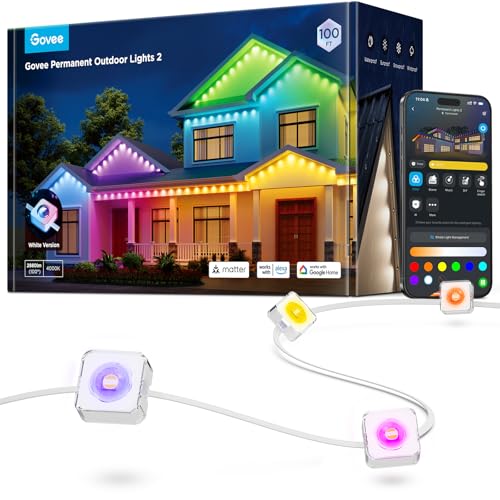
It undercut the Pro by $160 on 17 August 2026, and the gap has been as narrow as $110 at other prices we have recorded — but whatever the number that day, most of what the premium buys is something an Alexa or Google household never touches. You still get 100ft of RGBIC coverage, the same IP67 build, and 16 million colors under independent node control across the roofline.
The scene count actually goes up. The spec sheet lists 100 modes here against the Pro's 75, spanning Halloween, Thanksgiving, Christmas, New Year's and a stack of everyday looks, and reviewers report scene switching and scheduling behave exactly as they do on the flagship. The DIY editor builds patterns node by node, so a custom gradient or chase still reads cleanly from the street.
What you give up is native Matter and the SmartThings and Apple Home path. That is the whole gap. If neither is on your list, this is the smartest buy in the guide — though 100ft still runs short on a big two-story roofline.
Pros:
- 100ft RGBIC with 16 million colors and independent node control
- 100 scene modes — more presets than the Pro flagship
- Works with Alexa and Google Assistant
- IP67 weatherproof build
- Always the cheaper of the two Govees — $160 less than the Pro flagship as of 17 August 2026
Cons:
- No native Matter or Apple Home support
- Control box still needs a sheltered outlet location
- Not the longest run if you have a large two-story roofline
3. Nanoleaf Matter Permanent Outdoor Lights — Best for Apple / Matter Homes
Price: ~$349.99 Check price
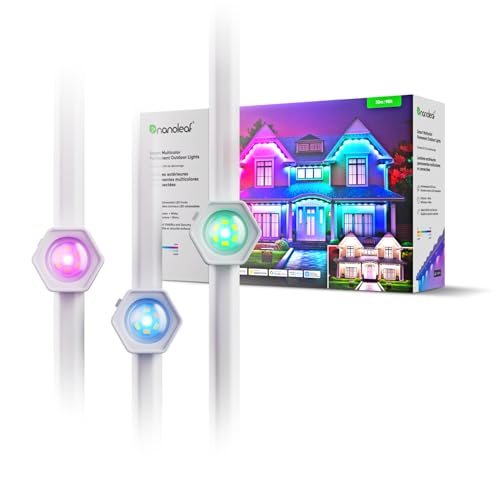
The white channel is the spec that decides this one. Nanoleaf's RGBCW nodes carry dedicated cool and warm white diodes, so the everyday glow comes out of a real white LED rather than being mixed from red, green and blue — the difference between tasteful year-round accent lighting and a roofline that reads faintly yellow.
Matter certification is the other half of the case. Reviewers report it drops into Apple Home cleanly alongside Alexa and Google, making it the natural pick for an iPhone household or a Matter-first build. The app carries scene modes for the major holidays plus custom color creation, and the IP67 housing takes year-round exposure.
At $349.99 it undercuts the Govee Pro while keeping native Matter — a combination the Govee Lights 2 doesn't offer at any price. It is no longer the cheapest door into Matter-adjacent lighting: the non-Matter Lights 2 undercut it by $70 on 17 August 2026, and trails it by at least $20 at every price we have recorded.
You accept two real limits for that white channel. 98ft is the shortest run in this guide, and the preset library is smaller than the Lights 2's.
Pros:
- Matter-certified — clean Apple Home, Alexa, and Google integration
- RGBCW nodes with dedicated warm and cool white channels
- 98ft coverage suits most single-story and many two-story homes
- IP67 weatherproof build
- Native Matter support at a lower price than the Govee Pro
Cons:
- Shorter run than the KISUFU for large rooflines
- Smaller scene-preset library than the Govee Lights 2
- Premium pricing versus budget RGBIC systems
4. KISUFU 200FT RGB+IC Permanent Outdoor Lights — Best Budget
Price: ~$48.00 Check price

$48.00 buys 200 feet — twice the run of the $439.99 flagship for about a ninth of the money. The surprise is how little it feels like a bare-bones system: RGB+IC lighting on a 24V supply, 221 scene modes, and both app and remote control, so a color change doesn't always require finding your phone.
The IP68 rating is the highest here, a step above the IP67 on every other pick, which means the housing is sealed against continuous water exposure rather than temporary immersion — reassuring in a wet or snowy climate. The independent (IC) node control runs the same chases and gradients as far pricier systems, and 200ft covers most single-story homes or a targeted stretch of a larger one.
The trade-offs arrive where you'd expect at this price. The app is functional, not polished; there is no Matter and no dedicated warm-white channel; and KISUFU is a newer brand with a short track record. For renters, first-time buyers, or anyone testing the idea before committing to a flagship, that is a fair exchange.
Pros:
- Most affordable pick in this roundup at $48.00
- IP68 waterproof — the highest rating here
- 200ft of RGB+IC lighting on a 24V supply
- 221 scene modes with both app and remote control
- Independent node control for chasing and gradient effects
Cons:
- App is basic compared with Govee or Nanoleaf
- No Matter or dedicated warm-white channel
- Newer brand with a shorter track record
Who Should Buy What
The four picks split by household, not by budget alone:
- Mixed smart-home platforms, or an Apple household that wants the most capable system — the Govee Pro at $439.99. Native Matter across Apple Home, Alexa, Google and SmartThings is what nothing else here does as completely.
- Alexa or Google only — the Govee Lights 2 at $279.99 (checked 17 August 2026). You lose Matter, you keep the RGBIC control and the IP67 build, and you gain 25 more preset scenes than the Pro for $160 less.
- An iPhone house that wants great everyday white — the Nanoleaf at $349.99. The dedicated warm and cool white diodes are the reason to pay more than the Lights 2 — $70 more on 17 August 2026, less at other prices we have recorded.
- A first system, a rental, or a test of the whole idea — the KISUFU at $48.00. IP68, 200ft, app and remote; you give up Matter and the white channel.
- A large two-story house plus outbuildings — nothing here covers that on one purchase. The KISUFU's 200ft is the longest run in this guide, so plan on two kits, or a premium run plus an extension.
When to Install, and Why It Isn't December
Here is the part most buyers miss: this is a warm-weather job. The adhesive strips and snap-in clips these systems rely on bond best in the heat, and rooftop and ladder work is far safer when temperatures sit above roughly 50°F and the eaves are dry.
That makes late spring through fall the window to mount a system, dial in the setup, and be ready long before the December rush. After that the ladder stays in the garage, and the holidays become an app tap.
What Are Permanent Outdoor Christmas Lights?
Permanent outdoor Christmas lights — also called eave lights, architectural lights, or roofline lights — are LED systems designed to be installed once and left in place permanently. They mount via small clips or adhesive into the channel at the edge of your eaves or roofline, then stay there year-round.
Unlike traditional string lights, they are:
- Weatherproofed to IP67 or IP68 standards — rated for years of rain, snow, heat, and UV
- App-controlled — change colors, patterns, and schedules from your phone, and on some systems by voice or physical remote
- Multi-holiday — not just Christmas. Halloween orange and purple, 4th of July red/white/blue, sports-team colors, or just warm white for everyday use
- RGBIC or RGBCW — capable of millions of color combinations, with the better systems adding dedicated white channels for a cleaner everyday glow
Installation Overview
Permanent eave lights are designed for DIY installation. Here is what the job looks like on most homes:
Step 1: Measure your roofline. Walk the perimeter of your home at eave level and note the total linear footage. Add about 10% for corners and routing, then choose a length that covers it — 98–100ft suits most single-story homes, while a 200ft run handles larger two-story houses.
Step 2: Choose your mounting method. Most systems use a small plastic clip that snaps into the drip edge (the metal channel at the edge of your eave), or adhesive strips for homes without a channel. Warm temperatures help adhesive bond firmly, so plan the install for a dry day above roughly 50°F.
Step 3: Plan your power source. You'll need a weatherproof outdoor outlet near the control box. Most control boxes have a 6–10ft power cable, so run an outdoor-rated extension cord if needed, or have an electrician add a dedicated outdoor outlet.
Step 4: Space and install the clips. Space clips per the manufacturer recommendation — typically every 12–18 inches — and snap the light cable into each clip as you go, working along the roofline.
Step 5: Connect and configure. Plug in the control box, download the companion app, and follow the setup wizard. Most systems pair via Bluetooth first, then join Wi-Fi for full remote and voice control.
Time required: roughly 2–4 hours for a typical single-story home, longer for large two-story rooflines. A second person makes corner management and ladder work easier and safer.
For a full DIY-versus-professional cost breakdown, see our permanent Christmas light installation cost & DIY guide. And if you are weighing a professionally installed system against the plug-in kits on this page, our Jellyfish vs Trimlight vs Gemstone cost comparison sets out what each of those three brands publishes per linear foot, which of them allow DIY at all, and how their warranties actually differ.
What to Look For
RGBIC vs. RGB: RGBIC (and RGB+IC) means each node is independently addressable — you can run a gradient or chasing effect across your roofline. Standard RGB shows the same color on every node at once. Every pick in this guide offers independent control, but confirm it if you're comparing against cheaper systems elsewhere.
Warm-white quality: Not all systems produce a quality warm white. Picks with a dedicated white channel — like the Nanoleaf's RGBCW nodes — render a cleaner everyday glow. RGB-only systems produce warm white by mixing red, green, and blue, which can look yellowish or dim by comparison.
Coverage length: Match the run to your roofline. The KISUFU's 200ft is the longest run here, so for large or multi-building properties plan on combining runs; 98–100ft systems suit most single-story homes. Buying too short forces awkward extensions; buying long gives you room to expand later.
IP rating: IP67 means protected from temporary immersion in water; IP68 (the KISUFU) means protected from continuous submersion. Both are more than enough for eave use — either is fine. Avoid anything rated below IP65.
Smart platform / Matter: If you use Apple Home, prioritize Matter-certified systems like the Govee Pro or Nanoleaf. If you're Alexa- or Google-only, any system here works. If you don't use smart-home platforms at all, an app-and-remote system like the KISUFU is plenty.
If you'd rather have seasonal string or tree lighting than a permanent eave install, see our guide to the best smart app-controlled string lights.
Bottom Line
Buy the Govee Permanent Outdoor Lights Pro at ~$439.99 if you want the roofline to answer to whatever platform your house already runs. Matter is what the other flagships either skip or price differently, and the 60 independently addressable nodes are what make the effects worth having.
Skip it if you are Alexa- or Google-only: that household pays a premium — $160 on 17 August 2026 — for a standard it will never call, and the Govee Lights 2 at $279.99 does the rest of the job with more presets.
Last updated: August 2026. Prices, sellers, and availability were verified on 2026-08-17 and change on their own schedule — confirm current details through the links above before buying.
Frequently Asked Questions
When is the best time to install permanent outdoor lights?
Late spring through fall is the ideal window. The adhesive and clips these systems use bond best in warm, dry conditions, and rooftop or ladder work is far safer when temperatures stay above roughly 50°F. Installing in summer means the system is mounted, configured, and tested long before the December rush — after which every holiday is just an app tap.
How long do permanent outdoor lights last?
Most manufacturers rate their LED systems for tens of thousands of hours of use, which translates to many years at a few hours per day. Real-world lifespan depends on UV exposure and connection quality, but a well-installed IP67 or IP68 system should comfortably last several years without issues.
Can I install permanent lights myself?
Yes — every system in this guide is designed for DIY installation. The most common stumbling blocks are routing lights around corners and locating a nearby power source. If your home doesn't have an outdoor outlet near the roofline, factor in the cost of adding one, and consider a second person for the ladder work.
Can I use these for holidays other than Christmas?
That's the whole point. Every system here ships with scene modes for Halloween, 4th of July, New Year's, and more — the Govee Lights 2 alone lists 100 scenes and the KISUFU 221 — plus custom color creation for any occasion, sports team, or everyday warm-white look.
What's the difference between permanent lights and regular string lights?
Traditional Christmas string lights are meant to go up and come down each season. Permanent lights mount in weatherproof housings with UV-resistant cables intended to stay up for years. The clips are designed for drip-edge or adhesive installation and hold the cable tight to the eave rather than hanging freely.
Do I need a Matter-compatible system?
Only if you use Apple Home or want a single standard across a mixed smart-home setup — in which case the Govee Pro or Nanoleaf are the picks to choose. If you run Alexa or Google Home, the Govee Lights 2 works fine, and if you don't use voice platforms at all, an app-and-remote system like the KISUFU covers everything you need.
Get our Christmas gear picks
Holiday deal roundups and updates when our top picks change.
No spam, ever. Unsubscribe anytime.
Sources & Methodology
Methodology: ChristmasGearHQ guides are researched on an expert-verification model. Specifications, dimensions and capability claims are taken from the manufacturer's own published material and, where available, independent published reviews, and are attributed in the text to the source that published them. Where two sources disagree, we say so and name both rather than picking one. We do not make first-person hands-on testing claims.
Prices, sellers and availability are read from the live product page and move on their own schedule — confirm the current figure through the links above before buying. Edited by Nicholas Miles, Chief Editor. Corrections: contact us.
More Guides
- Christmas LightsBest Giant Lighted Outdoor Christmas Trees 2026: 6 to 20 Foot Cone, Flagpole, Spiral and 3D Picks
- Christmas LightsJellyfish vs Trimlight vs Gemstone - What Permanent Christmas Lights Cost in 2026
- Christmas LightsBest Smart Outdoor Plugs & Timer Zone Kits for Christmas Lights 2026
- Christmas LightsChristmas Light Power, Mounting & Cable Accessories 2026