Warm White vs Multicolor Christmas Lights — 2026 Decision Guide
Warm white vs multicolor vs cool white Christmas lights for 2026 — which reads best on your house, how color temperature and brick or trim change the answer, and when to mix.
This article contains affiliate links. If you purchase through these links, we may earn a commission at no extra cost to you. Learn more.
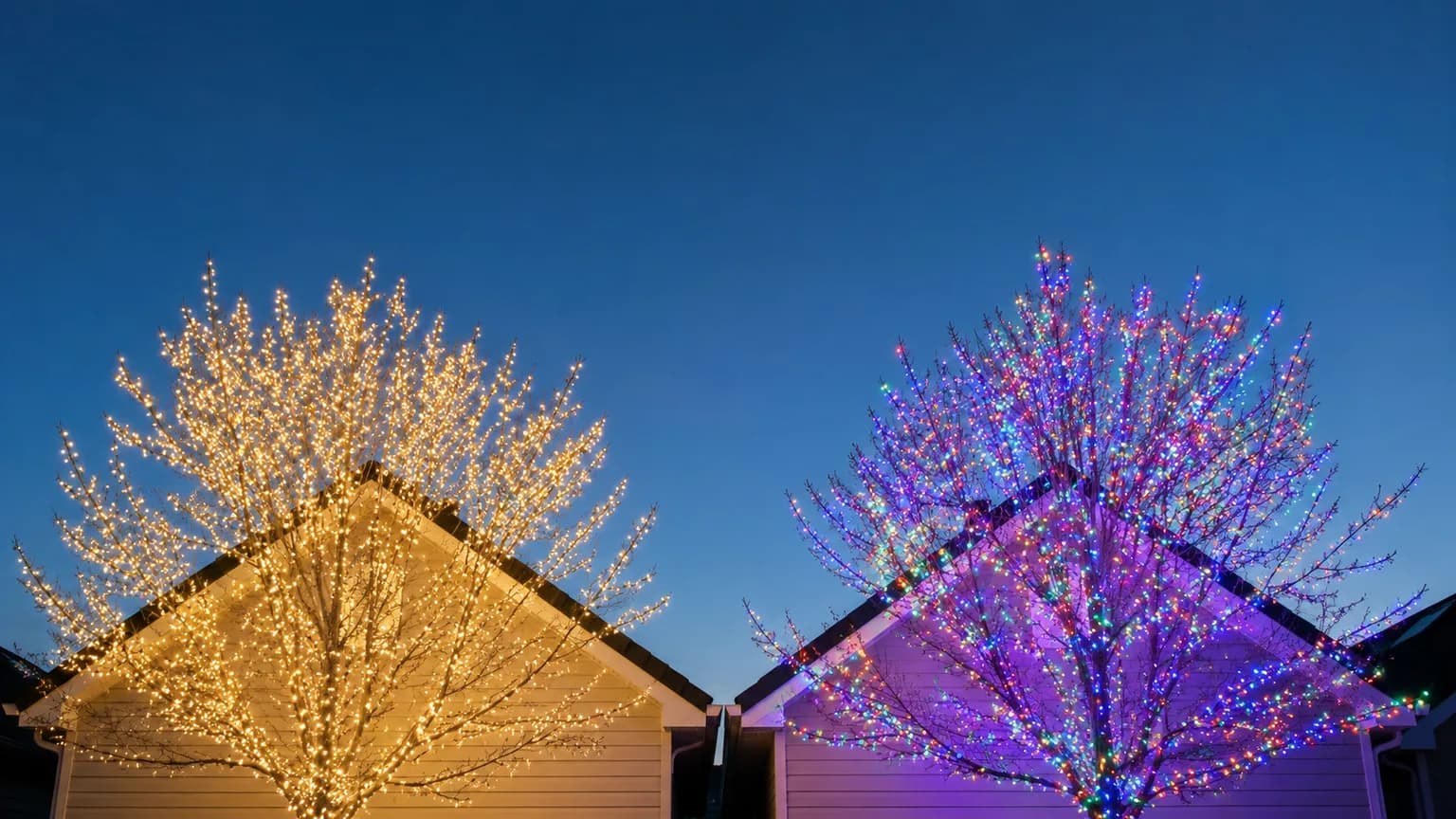
| Warm White | Cool White | Multicolor | |
|---|---|---|---|
| Mood | Classic, cozy, upscale | Crisp, modern, icy | Festive, playful, nostalgic |
| Best on | Brick, stone, warm/neutral trim | White, gray, modern exteriors | Family displays, colorful trim |
| Watch-outs | Can read yellow against cool-toned houses | Can look cold or clinical | Can read busy or dated if overdone |
The color decision gets made in the store aisle in about four seconds, and then it governs how a display looks for years. It deserves more than four seconds. Warm white, cool white, and multicolor are not just three flavors of the same thing — they set completely different moods, flatter different houses, and age differently against brick, siding, and trim. Buy the wrong one and even a perfectly-installed run can read cold, garish, or oddly dated.
This is a pre-purchase decision guide, not a product list. It works through when each color wins, what color temperature actually means once you get past the marketing words, and how the color of your own house quietly makes the choice for you. A couple of concrete picks are named where a warm-white example helps, but the goal is to send you shopping any roundup already knowing which column you belong in.
Deciding this in summer, before the seasonal rush, has a real payoff: you can look at your house in daylight, judge the brick and trim honestly, and buy once — instead of grabbing whatever's left on a December shelf.
Most disagreements about Christmas lights are really disagreements about this table. Warm white is the "tasteful and architectural" vote; multicolor is the "fun and traditional" vote; cool white is the modern middle path. None is wrong — but each one belongs on a different house and serves a different goal.
What Color Temperature Actually Means
The words "warm" and "cool" describe a measured value: color temperature, in Kelvin (K). Lower numbers are warmer and more golden; higher numbers are cooler and bluer. It runs backwards from how the words feel, which trips people up.
- Warm white sits low on the scale, around 2700K — the amber, candle-adjacent glow most people picture as "classic Christmas lights."
- Cool white sits high, around 5000K to 6500K — a crisp, bluish-white closer to daylight or a modern LED bulb.
- "White" LEDs vary wildly between brands, so two boxes both labeled "warm white" can land in noticeably different places. When year-round or architectural use is the goal, the quality and consistency of that white matters as much as the number.
Multicolor sidesteps Kelvin entirely — it is a set of saturated hues rather than a point on the white scale — which is exactly why it reads as festive rather than architectural. It is decoration first; the others can double as lighting.
Callout — why cheap "warm white" sometimes looks yellow. Budget LEDs produce white by tinting the diode rather than blending dedicated channels, so an off-spec "warm" white can skew genuinely yellow. If the white is going to run on ordinary nights and not just in December, it is worth choosing a set known for a clean, consistent tone.
When Warm White Wins
Warm white is the default for anyone who wants the display to look upscale and intentional rather than overtly festive. It flatters traditional materials, and it is the only one of the three that doubles convincingly as everyday exterior lighting outside the holidays.
Choose warm white when:
- Your house is brick, stone, or warm-toned siding — the golden light and the material reinforce each other.
- You want the display to read architectural and restrained, closer to landscape lighting than holiday decor.
- The lights will stay up or stay on beyond the season, where a warm glow reads as tasteful accent lighting.
- You are outlining a roofline or trim and want the clean, high-end look professionals favor.
Concrete examples of the look: a commercial-grade warm white 50-foot 100-count set at about $25.99 covers a long run cleanly, while the larger-bulb Wintergreen C9 OptiCore warm-white set at about $49.99 gives the chunky candle-bulb silhouette on a roofline. Both lean into the classic, architectural end of the spectrum.
When Cool White Wins
Cool white is the modern choice, and it lives or dies by the house behind it. Against the right exterior it looks clean and contemporary; against the wrong one it looks cold.
Choose cool white when:
- Your house is white, gray, black-trimmed, or modern in style — cool light echoes the palette instead of fighting it.
- You want a crisp, icy, "winter" effect rather than a cozy one — it pairs naturally with blue and silver schemes.
- You are lighting snow, evergreens, or metallic decor, where the cooler tone reads sharp and clean.
Where cool white struggles is on warm-toned brick and against warm-white lights nearby — mix the two and the cool run can look faintly blue and "off" next to the golden one. Pick a lane per surface.
When Multicolor Wins
Multicolor is the traditional, joyful choice, and it is unbeatable at the one thing it does: reading unmistakably as celebration. It is the nostalgic pick, the family pick, the one that photographs as fun.
Choose multicolor when:
- The display is for the joy of it — kids, a festive front yard, an unapologetically traditional look.
- You want instant holiday signal from the street, no subtlety required.
- Your trim or décor is already colorful, so saturated lights extend the palette rather than clash with it.
The honest watch-out is restraint. Multicolor can tip from festive into busy when it is spread across every surface at once. The displays that work usually anchor with one dominant treatment and let color live in a defined zone — a tree, a fence, a single roofline — rather than everywhere. If you are planning a whole-scheme look, the Christmas decor theme and color scheme planning guide handles the indoor palette side that complements the bulb-color decision here.
How Your House Decides More of This Than You Do
The single most reliable rule in this whole guide: let the house's fixed colors lead, and choose lights that agree with them.
- Red or warm brown brick has warm undertones. Warm white harmonizes; cool white can look sickly against it.
- White, gray, or cool siding takes cool white cleanly and can look slightly yellow under warm white if you want a crisp effect — though warm white still works if cozy is the goal.
- Trim color matters as much as the walls. Dark trim frames bright bulbs dramatically; white trim washes out under cool white but glows under warm.
- Landscape lighting you already run sets an expectation — matching your holiday whites to it keeps the whole exterior coherent instead of clashing at the property line.
A five-minute test beats any rule: on the next warm evening, hold a warm-white strand and a cool-white strand up against your actual brick or siding after dark and look from the curb. The winner is usually obvious in person in a way it never is on a box.
Mixing Colors Without Making a Mess
Mixing is where displays go wrong, but a few principles keep it clean:
- Pick one white and commit. Don't run warm white on the roof and cool white on the shrubs — the mismatch reads as an accident. Consistency across surfaces is what separates designed from cluttered.
- Let color live in a zone. If you want multicolor, give it a defined home — the tree, the fence, one roofline — anchored by white everywhere else.
- Match the everyday layer. For year-round systems, the white you run 11 months of the year should be the white that looks best on your house; save color for the season.
- Fewer moves, more impact. One confident treatment beats three competing ones. Restraint is the difference between elegant and chaotic.
Permanent RGB eave systems sidestep the choice entirely — warm white on ordinary nights, full color for the holidays; our Govee vs Nanoleaf comparison grades both systems on exactly that white-quality-versus-color-scenes tradeoff.
For the full menu of bulb shapes to apply your chosen color to, see the Christmas light types explained hub, and for the specific strands and displays to buy once you've chosen, the best Christmas string lights and LED displays roundup.
Last updated: July 2026. Prices may vary on Amazon — check current pricing via the links above.
Frequently Asked Questions
Is warm white or multicolor better for outdoor Christmas lights?
Neither is universally better — they serve different goals. Warm white reads upscale and architectural and doubles as year-round accent lighting, so it suits brick, stone, and anyone wanting a restrained look. Multicolor reads festive and traditional and is the stronger pick for a joyful, family-facing display. The deciding factors are your house color and whether you want "tasteful" or "celebratory."
What color temperature is warm white for Christmas lights?
Warm white typically lands around 2700K — the low, golden end of the Kelvin scale that produces the classic amber holiday glow. Cool white sits much higher, roughly 5000K to 6500K, giving a crisp bluish-white. Remember the scale runs backwards from the words: lower Kelvin is warmer, higher Kelvin is cooler.
Can I mix warm white and multicolor lights?
Yes, and it often looks best when you do it deliberately. The reliable formula is to anchor the display with warm white on the architecture and let multicolor live in one defined zone, like a tree or a fence. What to avoid is mixing two different whites across surfaces — a warm-white roof beside a cool-white shrub reads as a mistake rather than a design.
Why do my warm white LED lights look yellow?
Inexpensive LEDs create white by tinting the diode rather than blending dedicated channels, so an off-spec "warm white" can skew genuinely yellow instead of a clean gold. Brand and quality vary widely even within the "warm white" label. If the lights will run year-round or serve as everyday lighting, it's worth choosing a set specifically noted for a clean, consistent tone.
Which Christmas light color is best for curb appeal and resale?
Warm white is the safest choice for broad curb appeal because it reads as tasteful architectural lighting rather than seasonal decor, and it flatters the widest range of home exteriors. Treat any resale angle as a bonus rather than the reason to buy — buyers respond to a coherent, well-matched exterior far more than to any single bulb color.
Does cool white look good on a brick house?
Usually not. Red and warm-brown brick has warm undertones that cool white tends to fight, leaving the light looking cold or slightly off against the wall. Warm white is the more reliable match for brick. Cool white earns its place on white, gray, black-trimmed, or modern exteriors, and alongside blue-and-silver or snow-and-evergreen schemes.
Get our Christmas gear picks
Holiday deal roundups and updates when our top picks change.
No spam, ever. Unsubscribe anytime.
Sources & Methodology
Methodology: ChristmasGearHQ guides are researched on an expert-verification model. Specifications, dimensions and capability claims are taken from the manufacturer's own published material and, where available, independent published reviews, and are attributed in the text to the source that published them. Where two sources disagree, we say so and name both rather than picking one. We do not make first-person hands-on testing claims.
Prices, sellers and availability are read from the live product page and move on their own schedule — confirm the current figure through the links above before buying. Edited by Nicholas Miles, Chief Editor. Corrections: contact us.
More Guides
- Christmas LightsBest Giant Lighted Outdoor Christmas Trees 2026: 6 to 20 Foot Cone, Flagpole, Spiral and 3D Picks
- Christmas LightsJellyfish vs Trimlight vs Gemstone - What Permanent Christmas Lights Cost in 2026
- Christmas LightsBest Smart Outdoor Plugs & Timer Zone Kits for Christmas Lights 2026
- Christmas LightsChristmas Light Power, Mounting & Cable Accessories 2026