Christmas Light Types Explained — The 2026 Buying Guide
Christmas light types explained for 2026 — LED vs incandescent, mini and fairy, C7 and C9, net, icicle, rope, and permanent eave lights, plus indoor vs outdoor ratings and spacing.
This article contains affiliate links. If you purchase through these links, we may earn a commission at no extra cost to you. Learn more.
Quick picks from this guide
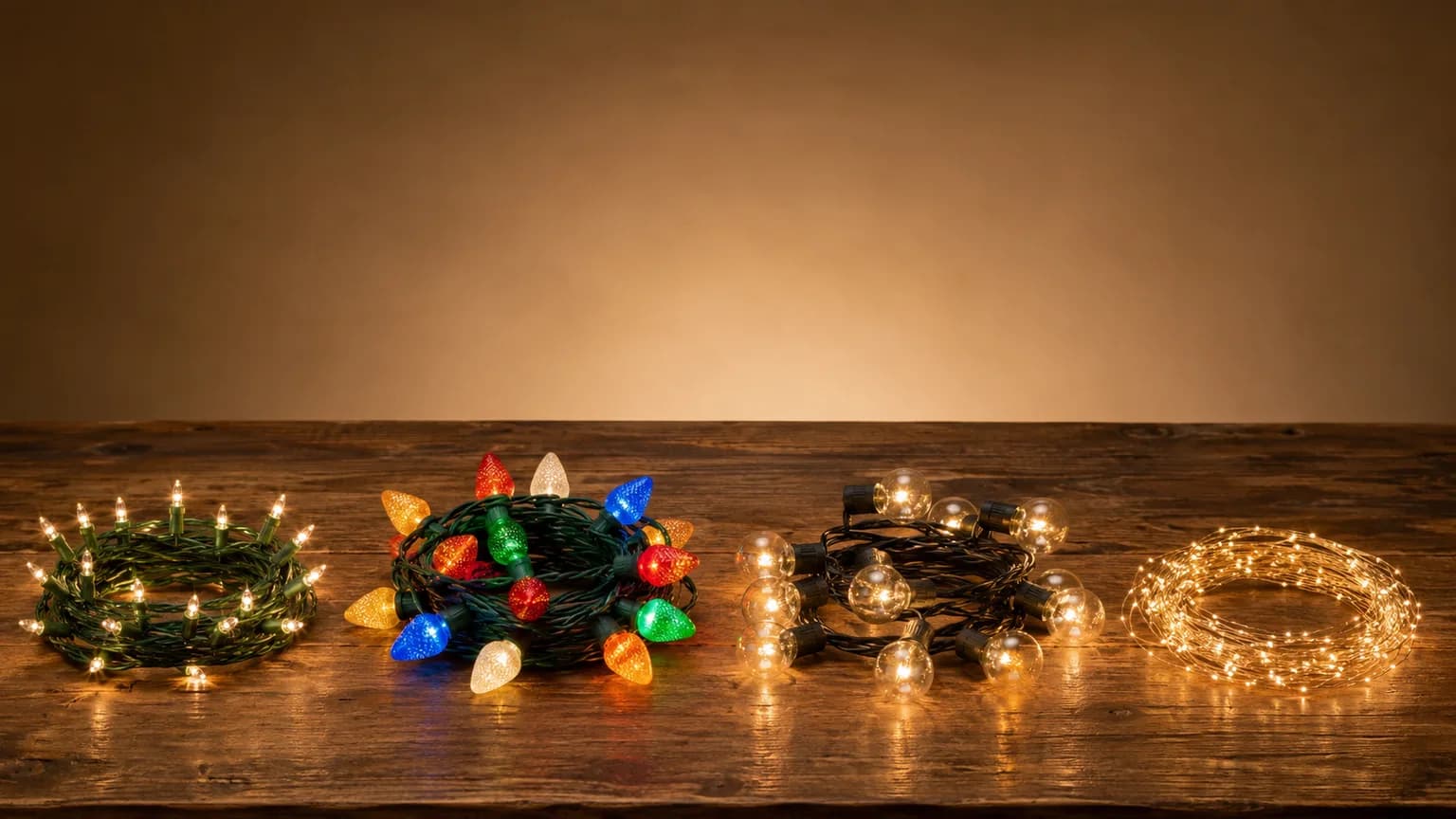
| Type | Look | Best Use | Indoor / Outdoor |
|---|---|---|---|
| Mini / Fairy | Tiny pinpoint bulbs on thin wire | Trees, garland, wrapping columns and banisters | Both (check the rating) |
| C7 | Small candle-shaped bulbs, ~1.5 in tall | Roof trim, small trees, retro looks | Both |
| C9 | Large candle-shaped bulbs, ~2.5 in tall | Rooflines, walkways, high-visibility outlines | Primarily outdoor |
| Net | A grid of bulbs on a mesh | Shrubs, bushes, hedges — even coverage fast | Outdoor |
| Icicle | Vertical drops of varying length | Eaves, gutters, fence lines | Outdoor |
| Rope | A continuous tube of light | Railings, wrapping outlines, pathways | Both (rated versions) |
| Permanent / Eave | Fixed RGB nodes in weatherproof housings | Year-round roofline lighting, app-controlled | Outdoor |
Walk down the seasonal aisle in July and the labels blur together: mini lights, fairy lights, C7, C9, net, icicle, rope, permanent eave systems. They are not interchangeable. Each shape was built for a specific job — wrapping a banister, outlining a roofline, blanketing a shrub — and buying the wrong form is how people end up with three tangled boxes that never quite fit the space they had in mind.
This is the foundational guide the rest of the ChristmasGearHQ library points back to. It explains the categories rather than ranking products: what separates LED from incandescent, what each bulb form is actually good at, how to read an indoor-versus-outdoor rating, and the wattage, spacing, and spooling basics that decide whether a run looks clean or chaotic. Where a concrete example helps, a few anchor picks are named inline — but the point here is to leave you able to shop any of the deeper roundups without guessing.
Because the smartest time to sort all of this out is well before December — when stock is deep, prices are calm, and a warm dry afternoon makes outdoor test-fitting easy — mid-summer is exactly when this decision belongs.
Every category below expands on one of these rows. Read the two or three that match your project and skip the rest.
LED vs Incandescent: Start Here
Before shape, settle the bulb technology, because it changes running cost, safety, and how many strands you can connect end to end.
LED is now the default for good reason. The diodes sip a fraction of the power of old filament bulbs, run cool to the touch, and shrug off the drops and jostling that shatter glass. Because each bulb draws so little current, you can chain far more LED strands into a single run before overloading the circuit — a practical advantage that matters the moment you try to outline a whole house. The one honest trade-off is color rendering: cheaper LEDs can push a slightly blue or clinical "white," which is why white-light quality is worth scrutinizing (more on that below).
Incandescent bulbs are the traditional filament lights. They throw a warm, forgiving glow that many people still associate with the holidays, and they cost less per box up front. But they burn hot, draw far more power, fail more often, and strictly limit how many strands connect safely in series. For most 2026 buyers the math favors LED — the exception is a small nostalgic display where the classic look outweighs the running cost.
A quick rule: if a run will stay up for weeks, sit outdoors, or stretch past a couple of strands, choose LED. Save incandescent for short, sentimental, easily-reached indoor accents.
The Bulb and Form Types
Mini and Fairy Lights
The workhorse. Mini lights are the small bulbs most people picture on a Christmas tree; "fairy" lights are the even smaller variant, often on a hair-thin wire that disappears into greenery. They excel at wrapping — trunks, branches, banisters, columns — and at filling a tree with even light. Spacing between bulbs determines the density of the look, so a tightly-spaced strand reads lush while a widely-spaced one reads sparse. For the full field of app-controlled and classic string options, see the best Christmas string lights and LED displays roundup.
C7 and C9 Bulbs
These are the classic candle-shaped bulbs, and the number is a size, not a wattage. C7 is the smaller of the two — roughly the size of a nightlight bulb — and reads well on roof trim, smaller trees, and tighter retro displays. A clean budget example of the form is the Novelty Lights C7 Clear 25-foot set at about $19.98, an indoor/outdoor strand on green wire.
C9 is the larger bulb — the fat, high-visibility candle shape you see outlining rooflines and walkways from down the block. Its size makes it the go-to for big architectural outlines where a small bulb would simply disappear at distance. A representative commercial-grade LED example is the Wintergreen 25 C9 OptiCore set at about $49.99 for a 25-foot warm-white run on green wire. If you are outlining a house in C7 or C9, the heavy-duty end of the category gets its own deep dive in the best C9 and C7 commercial Christmas lights guide.
Net Lights
Net lights are a mesh of bulbs on a grid, and their entire reason for existing is speed. Instead of hand-wrapping a shrub strand by strand, you drape a net over the top and the coverage is instant and even. They are sized to the bush rather than measured in feet of run, so match the net dimensions to the plant. This is the fastest way to light foundation shrubs and hedges — covered in full in the best Christmas net lights for bushes and shrubs guide.
Icicle Lights
Icicle lights hang as vertical drops of varying length off a horizontal wire, mimicking hanging ice. They are made for eaves, gutter lines, and fence tops, where the staggered drops create movement along an edge. Drop length and the number of drops per foot determine how dense and dramatic the curtain looks. The dedicated roundup is the best outdoor icicle Christmas lights guide.
Rope Light
Rope light encases the bulbs in a flexible tube, so instead of individual points you get a continuous glowing line. That makes it ideal for tracing railings, wrapping posts, edging pathways, and any place you want a solid outline rather than a dotted one. Look for an outdoor-rated version if it will live outside; the tube resists moisture but the rating still governs how it handles standing water.
Permanent / Eave Lights
The newest category. Permanent lights are weatherproof RGB nodes fixed into the roofline once and controlled from a phone year-round — Christmas red-and-green in December, orange in October, warm white on an ordinary Tuesday. They replace the annual ladder trip entirely. Because they are an install-once system rather than a seasonal strand, they get their own treatment in the best permanent outdoor Christmas lights roundup.
Indoor vs Outdoor Ratings
The single most common mistake is running an indoor-only strand outside. The label to find is the IP (Ingress Protection) rating, or at minimum an explicit "indoor/outdoor" marking.
- Indoor-only lights have no meaningful moisture sealing. A porch that gets wind-driven rain will kill them.
- Indoor/outdoor strands — like most C7, C9, and net sets — are built to handle weather exposure. Many budget sets state this plainly on the box.
- IP-rated systems carry a two-digit code. For outdoor holiday use, IP44 handles splashes and rain, IP65 handles low-pressure water jets, and IP67 survives temporary immersion. A permanent system living on the eaves year-round wants IP65 or better; a net light tucked into a shrub for the season can live comfortably at IP44.
If a listing does not state a rating or an indoor/outdoor designation, assume indoor-only and keep it under a roof.
Wattage, Spacing, and Spooling Basics
Three practical numbers separate a clean install from a frustrating one.
Wattage and max connections. Every strand lists a maximum number of sets you can connect end to end before overloading the first plug. LED strands allow far longer chains than incandescent because each bulb draws so little. Exceed the limit and you trip a fuse or, worse, cook the wiring — so count your strands against the box's stated maximum before you plug in.
Bulb spacing. The distance between bulbs sets the density of the look. Tight spacing reads full and premium; wide spacing stretches a strand further but looks sparse up close. When outlining architecture, denser spacing hides the gaps between light points at a distance.
Spooling and run planning. "Spooling" is the practice of buying bulk light on a reel plus separate sockets — common in the commercial C9/C7 world — so you cut the exact length you need instead of stitching fixed strands together. For pre-made strands, plan the run first: measure the space, add roughly 10% for corners and slack, and buy to that number. To turn a roofline or tree into an actual quantity, run it through the how many Christmas lights do I need calculator.
Callout — the extension-cord footnote. Your run length is only half the plan; the other half is reaching a weatherproof outdoor outlet. Measure the distance from the display to the nearest covered receptacle before you buy, and use outdoor-rated cord for anything exposed.
Warm White vs Multicolor, at a Glance
The last fork is color, and it is more consequential than it looks because it sets the entire mood of a display.
- Warm white reads classic, upscale, and architectural. It flatters brick, stone, and neutral trim and doubles as tasteful everyday lighting. A commercial-grade example is the warm white 50-foot 100-count set at about $25.99 on green wire.
- Cool white skews crisp and modern — clean against white or gray houses, colder against warm-toned brick.
- Multicolor reads festive, playful, and traditional, and it is the nostalgic choice for family displays.
Because this choice interacts with your house color, trim, and the effect you are after, it is worth deciding before you buy rather than at the top of the ladder. The full decision framework — including color temperature in Kelvin and how brick and trim change the answer — lives in the warm white vs multicolor Christmas lights guide.
For the heavy-duty end of the roofline category, the best C9 and C7 commercial Christmas lights guide covers spooled bulk runs and commercial-grade strands; and if app-controlled color is the goal, Smart Home Explorer's smart Christmas lights guide covers the connected tier of this taxonomy.
Last updated: July 2026. Prices may vary on Amazon — check current pricing via the links above.
Frequently Asked Questions
What is the difference between C7 and C9 bulbs?
Both are the classic candle shape; the number is the size. C7 is the smaller bulb, roughly nightlight-sized, and suits roof trim and smaller trees. C9 is the larger, higher-visibility bulb used to outline rooflines and walkways where a small bulb would vanish at a distance. Neither number refers to wattage — a common point of confusion.
Are LED Christmas lights worth it over incandescent?
For nearly every 2026 buyer, yes. LEDs use far less power, run cool, resist breakage, and let you chain many more strands into a single run without overloading a circuit. Incandescent still wins on pure nostalgic warmth and a lower box price, so it holds up for short, sentimental, easily-reached indoor accents — but not for long or outdoor runs.
Can I mix different light types in one display?
Yes, and the best displays usually do. A common formula pairs C9 bulbs on the roofline, net lights on the shrubs, and mini or fairy lights wrapping a tree or columns. The key is keeping the color temperature consistent across types — mixing a warm-white roofline with a cool-white shrub reads as a mistake rather than a design.
Which light type is easiest to install?
Net lights, by a wide margin, for shrubs and bushes — you drape rather than wrap. For architecture, rope light traces an outline in one continuous piece with no gaps to space out. Permanent eave systems are the most work up front but the easiest forever after, since the install happens only once.
Do I need outdoor-rated lights for a covered porch?
It is the safer choice. A covered porch still sees humidity, temperature swings, and wind-driven rain, all of which shorten the life of an indoor-only strand. An indoor/outdoor or IP-rated set costs little more and removes the guesswork. If a listing states no rating at all, treat it as indoor-only.
How many strands can I connect end to end?
It depends on the bulb technology and the strand's rated maximum, which is printed on the box. LED sets allow far longer end-to-end chains than incandescent because each bulb draws so little current. Never exceed the stated maximum connections — that limit exists to keep the first plug and its wiring from overheating.
What are the main types of Christmas lights?
Six forms cover nearly every display: mini and fairy lights for trees and dense wraps; C7 and C9 bulbs, the classic candle shapes for rooflines and walkways; net lights that drape over shrubs; icicle lights that hang from eaves; rope light for tracing an outline in one continuous piece; and permanent eave systems that install once and stay up year-round. Across all of them, the underlying technology choice is LED versus incandescent — and for most 2026 buyers, LED wins that one.
Get our Christmas gear picks
Holiday deal roundups and updates when our top picks change.
No spam, ever. Unsubscribe anytime.
Sources & Methodology
Methodology: ChristmasGearHQ guides are researched on an expert-verification model. Specifications, dimensions and capability claims are taken from the manufacturer's own published material and, where available, independent published reviews, and are attributed in the text to the source that published them. Where two sources disagree, we say so and name both rather than picking one. We do not make first-person hands-on testing claims.
Prices, sellers and availability are read from the live product page and move on their own schedule — confirm the current figure through the links above before buying. Edited by Nicholas Miles, Chief Editor. Corrections: contact us.
More Guides
- Christmas LightsBest Giant Lighted Outdoor Christmas Trees 2026: 6 to 20 Foot Cone, Flagpole, Spiral and 3D Picks
- Christmas LightsJellyfish vs Trimlight vs Gemstone - What Permanent Christmas Lights Cost in 2026
- Christmas LightsBest Smart Outdoor Plugs & Timer Zone Kits for Christmas Lights 2026
- Christmas LightsChristmas Light Power, Mounting & Cable Accessories 2026