Will a Train Fit Around My Christmas Tree? - Track Diameter, Clearance and the Arithmetic 2026
This article contains affiliate links. If you purchase through these links, we may earn a commission at no extra cost to you. Learn more.
The short answer
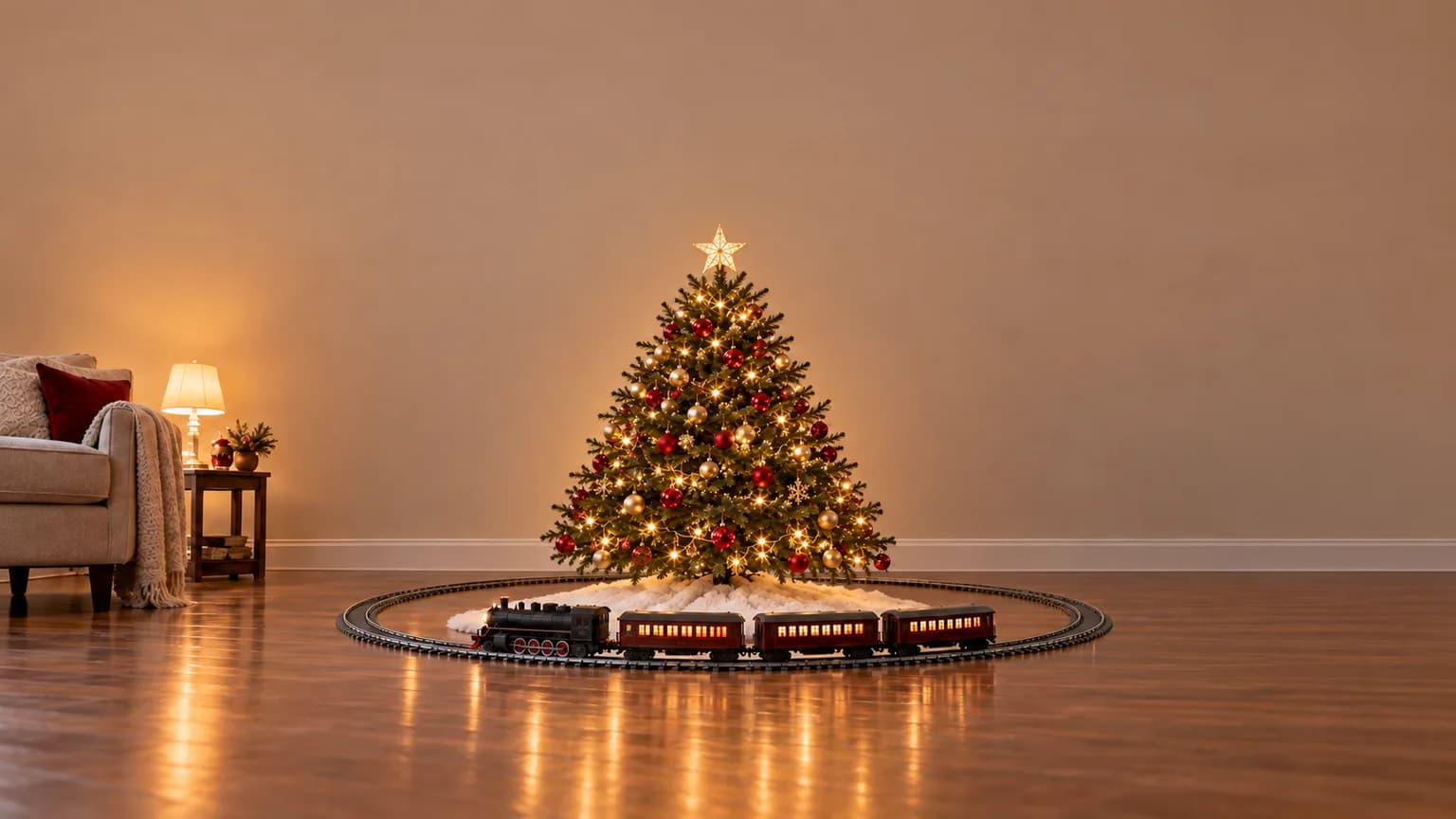
Take the curve diameter printed on the track — O36 means a 36-inch circle — and subtract roughly five inches before you compare it to anything. That is the track's own width plus a margin for the car bodies, which swing inward over the rails on a curve. A 36-inch O gauge loop leaves about 30 inches of genuinely clear circle in the middle, which fits a pencil or slim tree with a published base of 29 inches or under and fits nothing else. A full-profile 9-foot tree on a 66-inch base needs an 84-inch loop, and that loop occupies about a 7-foot-5-inch square of floor. The five-inch subtraction is this guide's own arithmetic, not a manufacturer figure, and the reason it is needed is that no manufacturer publishes one.
| FasTrack curve | Sections per circle | Turn per section | Diameter |
|---|---|---|---|
| O36 | 8 | 45° | 3 foot |
| O48 | 12 | 30° | 4 foot |
| O60 | 16 | 22.5° | 5 foot |
| O72 | 16 | 22.5° | 6 foot |
| O84 | 32 | 11.25° | 7 foot |
The Number Nobody Publishes
Our own roundup of Christmas train sets to run under the tree stops short at exactly this point, and says so in plain terms: "none of the four Lionel sets publishes the finished loop's outside dimensions. A curve designation is not a footprint, and this guide is not going to convert one into inches and present the result as a manufacturer figure."
That refusal was correct. This page does the conversion openly instead — showing the arithmetic, and naming which inputs are published specs and which are margins we chose.
Start with how thin the published record is. Lionel's own store page for the FasTrack O36 curve — the piece bundled in several current Christmas starter sets — describes it as "FASTRACK 036 45-Degree curved track (8 pieces per circle)". Piece count and angle, and that is the whole specification. No diameter appears on Lionel's own product page for a track piece whose name is a diameter.
The diameters circulating online come from retailers. Trainz, a large train dealer, publishes the table most often reproduced:
That is a retailer's table, not Lionel's, and it is worth knowing the difference before you plan a room around it.
The older tubular curves — the O27 and O31 designations that still appear as "minimum curve" specs on modern sets — are worse documented still. The figures in circulation (O27 at roughly 27 inches across the outer tie edges; O31 at roughly 31 inches) come from hobby reference sites, not from Lionel. We could not locate a Lionel-published dimension table for tubular track, and we are not going to dress a hobby blogger's measurements up as a manufacturer spec. Treat those two numbers as approximate and round up.
Loop Diameters by Scale and Gauge
Here is what each system's curve designation actually means, with the source of each figure named.
| System | Curve | Sections / circle | Stated diameter | Source of the figure |
|---|---|---|---|---|
| Lionel tubular (O gauge) | O27 | 8 × 45° | ~27" outer edge | Hobby reference sites; not published by Lionel |
| Lionel tubular (O gauge) | O31 | 8 × 45° | ~31" outer edge | Hobby reference sites; not published by Lionel |
| Lionel FasTrack (O gauge) | O36 | 8 × 45° | 36" | Angle and count from Lionel; diameter from retailer tables |
| Lionel FasTrack (O gauge) | O48 | 12 × 30° | 48" | Retailer tables |
| Lionel FasTrack (O gauge) | O60 | 16 × 22.5° | 60" | Retailer tables |
| Lionel FasTrack (O gauge) | O72 | 16 × 22.5° | 72" | Retailer tables |
| Lionel FasTrack (O gauge) | O84 | 32 × 11.25° | 84" | Retailer tables |
| Bachmann E-Z Track (HO) | 18" radius | 12 × 30° | 36" | Bachmann's own store page |
| Bachmann E-Z Track (HO) | 22" radius | 16 × 22.5° | 44" | Bachmann's own store page |
| Bachmann steel (Large Scale) | standard curve | 12 per circle | ~48" | Piece count from Bachmann; diameter from retail listings |
| PIKO G (Large Scale) | R1 | 12 × 30° | 47.2" (1200mm) | PIKO America's own product page |
| PIKO G (Large Scale) | R3 | 12 × 30° | 72.4" (1840mm) | PIKO America's own product page |
| LGB G (Large Scale) | R3 | — | ~94.1" (2390mm) | Hobby forum aggregation; not read from an LGB page |
Two rows deserve pulling out, because both catch buyers.
Bachmann's own HO listing does the arithmetic for you, and it is the clearest spec of the lot. The 18-inch radius E-Z Track page states that four pieces make "one-third (120 degrees) of a 36" diameter circle." Radius doubled equals diameter, twelve pieces per circle, no ambiguity. Bachmann's Large Scale steel curve page (item 94501) is less forthcoming: it gives "12 pieces make up a complete circle" and "Indoor track compatible with all Large Scale locomotives and rolling stock," but no diameter. The 4-foot figure comes from the retail listing title.
PIKO and LGB use the same curve names for different curves. PIKO America's own page for its R1 curve gives "Radius = 600mm / 23.6"" and "Diameter = 1200mm / 47.2"," which matches LGB's R1 exactly. Their R3 curves do not match at all: PIKO's own page gives R3 as 920mm radius, 1840mm (72.4") diameter, while the LGB R3 in general circulation is 1195mm radius, 2390mm (94.1") diameter. That is a difference of nearly two feet of floor between two curves wearing the same name.
Be candid about the second half of that comparison. The PIKO figures were read directly from PIKO America's own product pages. The LGB figures were not — LGB's published track-system document is a scanned PDF that would not yield machine-readable text, so the LGB column comes from a large-scale hobby forum's compiled translation table. It is consistent across several hobby sources, and PIKO's own page confirms the shared R1 row. Treat the LGB R3 figure as well corroborated rather than first-party, and confirm with the retailer before buying on the strength of it.
What the Stated Diameter Actually Measures
This is the step most buyers skip, and it is where the surprise comes from.
A curve's diameter is derived from its radius, and a radius is measured to the middle of the track — that is why PIKO's R1 page reads "Radius = 600mm" and "Diameter = 1200mm," exactly double. The number describes a circle running down the centre of the rails. It does not describe the hole in the middle, and it does not describe the floor the loop occupies. Both of those are different numbers, and they sit on either side of the one on the box.
Working outward from the stated diameter:
- Inside the loop, the inner rail sits half a track-width in from the centreline. O gauge is 1.25 inches between the outer rails, per Lionel's own FasTrack specification; HO is 16.5 mm (0.65 inches) and G scale is 45 mm (1.77 inches). So the inner rail circle is smaller than the stated diameter by that gauge figure.
- The moulded roadbed on snap-track systems extends further inward and outward than the rails do. Lionel's store page does not publish its width, so this guide puts no number on it — one more reason to round up rather than shave a fit.
- The cars overhang the rails on a curve. A rigid car body cuts inward at its middle and swings outward at its ends. Nobody publishes a figure for this. Lionel, Bachmann, LGB and Atlas publish minimum-curve compatibility instead, which says whether a locomotive will run on a curve, not how much air it needs beside it.
This guide's own margin, clearly labelled. Because no manufacturer publishes an overhang allowance, we use 2 inches per side for O gauge and HO's smaller equivalent of 1 inch per side, and 3 inches per side for G scale. These are our numbers, chosen from body size: the Disney Christmas Express publishes a train length of 45 inches across five pieces, so individual O gauge cars run around nine inches long, and G scale rolling stock is physically larger again. They are margins, not specifications. Anyone who needs the real figure for a specific locomotive should measure the car.
That gives two working formulas, both ours:
Clear circle inside the loop ≈ stated diameter − track gauge − (2 × overhang margin)
Floor the loop occupies ≈ stated diameter + track gauge + (2 × overhang margin)
The Conversion Table
Applying those two formulas to every curve above. The middle column is the one that decides whether your tree fits; the right-hand column is the one that decides whether your room does.
| Curve | Stated diameter | Clear circle inside | Floor occupied |
|---|---|---|---|
| O27 (tubular) | ~27" | ~21.75" | ~2 ft 8 in |
| O31 (tubular) | ~31" | ~25.75" | ~3 ft 0 in |
| O36 FasTrack | 36" | ~30.75" | ~3 ft 5 in |
| O48 FasTrack | 48" | ~42.75" | ~4 ft 5 in |
| O60 FasTrack | 60" | ~54.75" | ~5 ft 5 in |
| O72 FasTrack | 72" | ~66.75" | ~6 ft 5 in |
| O84 FasTrack | 84" | ~78.75" | ~7 ft 5 in |
| HO 18" radius | 36" | ~33" | ~3 ft 3 in |
| HO 22" radius | 44" | ~41" | ~3 ft 11 in |
| G scale R1 (PIKO/LGB) | 47.2" | ~39" | ~4 ft 7 in |
| G scale R3 (PIKO) | 72.4" | ~64" | ~6 ft 8 in |
| G scale R3 (LGB) | ~94.1" | ~86" | ~8 ft 6 in |
The O27 row is the one that catches people. A loop marketed as 27 inches across leaves under 22 inches of clear floor in the middle — tighter than the narrowest pencil tree in our slim and pencil tree roundup.
Worked Example One: A Slim Tree and an O36 Loop
National Tree Company publishes its 7-foot Kingswood Fir Slim on a 29-inch base — a manufacturer figure, taken from the listing.
An O36 FasTrack loop gives about 30.75 inches of clear circle. The tree needs 29. It fits, with roughly 1.75 inches to spare — under an inch on each side.
That is a fit on paper and a near-miss in a living room, because three things eat into it:
- Branch tips are not the base diameter. The published width is the intended fluffed spread, and a freshly fluffed tree runs a little wider until it settles.
- The skirt is usually wider than the tree — the single most common reason a loop that should have fitted does not. More on that below.
- The stand sits under the tree, not beyond it. Our tree stand roundup puts leg spans in the 24-to-28-inch range on the welded-steel picks, inside a 29-inch branch spread. The stand is rarely the binding constraint; the skirt and the lowest branch ring almost always are.
So an O36 loop around a 29-inch slim tree works with a small skirt or a collar, and fails with a skirt bought by the usual rule. Step up to O48 if there is any doubt — a foot more floor buys 12 more inches of clear circle.
Worked Example Two: A Full-Size 9ft Tree
Now the case that surprises everyone. National Tree Company publishes its 9-foot Dunhill Fir on a 66-inch base, and the 10-foot on a 70-inch base. Best Choice Products publishes its 9-foot spruce at 59 inches in diameter. These are the trees in our 9ft large tree roundup, and their widths are published on their own listings.
Run them against the conversion table:
| Tree | Published base | Smallest loop that clears it | Floor the loop needs |
|---|---|---|---|
| HOMCOM 6ft Noble Fir pencil | 21.75" | O31 (~25.75" clear) | ~3 ft 0 in |
| Kingswood Fir Slim 6.5ft | 28" | O36 (~30.75" clear) | ~3 ft 5 in |
| Kingswood Fir Slim 7ft | 29" | O36, barely | ~3 ft 5 in |
| Puleo Fraser Fir pencil 7.5ft | 30" | O48 — O36 leaves 0.75" | ~4 ft 5 in |
| Best Choice 9ft spruce | 59" | O72 (~66.75" clear) | ~6 ft 5 in |
| National Tree 9ft Dunhill Fir | 66" | O84 — O72 leaves 0.75" | ~7 ft 5 in |
| National Tree 10ft Dunhill Fir | 70" | O84 (~78.75" clear) | ~7 ft 5 in |
A full-profile 9-foot tree needs a 7-foot loop, and that loop claims a 7-foot-5-inch square of floor. In most living rooms that is the whole corner plus a walkway, and it is roughly four times the track a boxed starter set ships.
That is the honest answer to the question in the title, and not the one the picture on the box suggests. The classic image of a train circling a big family tree is a large-room image. In a normal room the train either circles a slim tree or runs past the tree rather than around it.
Note the two near-misses. The Puleo pencil at 30 inches inside an O36 loop, and the 9ft Dunhill at 66 inches inside an O72 loop, both clear by three-quarters of an inch on our margins. Three-quarters of an inch is not a fit. It is a derailment on the second lap, when a branch tip catches a roof line.
The Skirt Is the Binding Constraint
Retail skirt-sizing guidance is consistent and, for anyone running a train, actively unhelpful. The common rule across retailer buying guides: a skirt about six inches wider than the tree's widest point, with 48-inch skirts for 6-foot trees and 60 to 72 inches for trees of 7.5 feet and up.
We were not able to read the most-cited version of that guidance first-hand — Balsam Hill's skirt-sizing page returned an HTTP 429 rate-limit response on 2026-09-13 — so we describe the rule as it appears across several retailer guides rather than quoting any one company.
Apply it to the slim tree above and the problem is obvious. A 29-inch tree gets a skirt of roughly 36 inches. An O36 loop has about 30.75 inches of clear circle. The skirt is wider than the hole. The fabric sits on the rails, and the train either stalls against it or drags it around the corner.
Three ways out, best first:
- Use a tree collar instead of a skirt. A rigid collar has a fixed, published diameter that does not creep outward. The wooden collar in our stand guide is a 26-inch box, which sits comfortably inside an O36 loop where a 36-inch skirt does not.
- Buy the skirt a size down from the rule. The rule exists to make a skirt look generous. With a train, it needs to look contained.
- Run the skirt under the track. The Christmas Eve improvisation, and the worst of the three: fabric under snap-track lifts and separates sections.
Thick carpet causes the same problem with no skirt involved. Moulded-roadbed track sits on the pile rather than the floor, and hobbyists and retailers commonly report sections working loose on deep carpet. We could not pin that to a single authoritative source and will not attribute it to one — it is a widely repeated practical observation, and the fix is cheap: a thin mat, hardboard or foam board under the loop.
Two Layout Ideas, One of Which Does Not Work
The oval does not help you clear the tree. This is the most common piece of bad advice in the category. An oval is two half-circles with straights between them, so the long axis grows and the short axis stays exactly equal to the curve diameter. A tree in the middle has to clear that short axis. An O36 oval clears the same 30.75-inch tree as an O36 circle while occupying more floor. Ovals help you fit a loop into a rectangular room. They do nothing for tree clearance.
Raising the loop does help, and it is the underused answer. A tree is a cone: widest at the floor, narrower with every foot of height, so a loop on a platform meets a narrower slice of tree than one on the carpet. As rough arithmetic — ours, and assuming a regular taper that real trees only approximate — a 7.5-foot tree with a 30-inch base is around 24 inches across at 18 inches up. That is the difference between needing an O48 loop and fitting inside an O36.
The trade-offs:
- A raised loop needs a built ring or shelf — a weekend project rather than a purchase.
- You lose the visual people want: the train at skirt level, running past the presents.
- You gain the thing that actually kills floor loops. Come Christmas Eve the floor loop is buried under boxes, and no locomotive is going to shift a wrapped present.
A raised ring also puts the train at the eye level of a collectible village, the natural neighbour under a tree — our collectible village guide covers how those series are scaled.
Track Families Do Not Mix
If any of the arithmetic above tells you to buy a bigger loop than the one in the box, this section is the one that saves the order.
| System | Who makes it | Connects to |
|---|---|---|
| Tubular (round-pin) | Lionel, Williams by Bachmann | Other tubular; FasTrack only via Lionel's sold-separately adapter section |
| FasTrack (moulded roadbed) | Lionel | Other FasTrack; tubular only via the adapter |
| E-Z Track (moulded roadbed) | Bachmann | Other E-Z Track |
| Battery O Gauge (two-rail) | Lionel | Its own system — explicitly not Lionel Ready-to-Play |
Two rules follow.
A starter set's included loop is the minimum, not a choice. The eight curve sections in the box are sized to the tightest curve the included locomotive can negotiate — a compatibility decision, not a styling one.
Extra curves must come from the same family. FasTrack does not clip to tubular; E-Z Track clips to neither. Within FasTrack there is a further catch: O36, O60, O72 and O84 share the 45° / 22.5° / 11.25° angle family and combine section for section, while O48 uses 30° sections and does not mix with them angle for angle.
Locomotives are a separate question from track, and this trips people the other way. Rolling stock generally runs fine on any compatible-gauge track regardless of brand. It is the connectors and the roadbed height that refuse to interchange, not the running gear.
Power, Cords and What Sits Under the Skirt
A transformer cord has to reach the loop, and the only route that avoids a walkway usually runs under the tree skirt. That is the route worth thinking about twice.
NFPA's own Christmas tree fire report page did not return machine-readable text when we fetched it on 2026-09-13, so we report its widely circulated figures with that caveat rather than quoting the page: an average of around 155 Christmas tree home structure fires a year across 2018 to 2022, with electrical distribution and lighting equipment cited as the leading cause. Anyone wanting precise current figures should read NFPA's report directly rather than take ours.
The practical points do not depend on the exact number:
- Add the wattages, do not judge them separately. Lionel's CW-80 transformer, the wall pack bundled with many current sets, is published at 80 watts with a 0–18V variable output, rated to run "up to 4 locomotives and/or many accessories." Eighty watts is trivial alone. It is not trivial added to a heavily strung tree on the same outlet, and a 15-amp circuit carries roughly 1,800 watts in total.
- Do not run the cord under a rug or pinch it under the stand. Both are standard extension-cord warnings, and both are what a cord routed under a tree skirt invites.
- Inspect the cord before each season. It spends eleven months folded in a box; cracked insulation is the failure it comes back with.
- A battery set removes the question entirely — no cord crossing the floor, nothing running under the skirt.
Our Christmas light power, timers and safety planning guide covers circuit-load arithmetic across a whole display — the place to work out whether the train's 80 watts is the straw or a rounding error.
On the other kind of safety: Consumer Reports has no train-set review and no track-layout guidance, but its holiday toy-safety page is worth a minute for anyone buying a train as a child's gift. It notes that "the CPSC encourages manufacturers to clearly label toys with age guidelines, and the agency requires age labels to be accurate," and that federal rules "ban any toys intended for use by children younger than 3 from being or having small parts." Train-set age ratings vary widely inside a single brand's range, and they are about the contents, not the theme.
We checked the major home and consumer titles for coverage of this question — track geometry, clearance, or layout around a tree — and found none. Better Homes & Gardens, Architectural Digest, Martha Stewart Living, Real Simple, Good Housekeeping, Country Living, Crate & Barrel's editorial and Wirecutter have all published extensively on Christmas trees; none has published on this. That is why the sourcing here leans on manufacturer and retailer spec pages, and says so each time it cannot.
The Sets These Numbers Apply To
Our train set roundup has the full comparison, age ratings and buying advice. Prices below were last checked Sept 13, 2026, and Amazon's move on their own schedule; the relevant point here is the track each one ships with.
- Lionel Polar Express Electric O Gauge Bluetooth 5.0 — $479.99. No parts inventory and no loop dimension published, so the conversion table above is the only planning tool for it. Assume an O36-class loop and measure first.
- Bachmann Night Before Christmas RTR, G scale — $496.83, only 9 left on 2026-09-13. The one set publishing a finished footprint rather than a curve designation. G scale means the 3-inch-per-side margins above, not the O gauge ones.
- Lionel Disney Christmas Express O Gauge — $401.20. Eight O36 curved FasTrack sections, a minimum curve of O31, a 45-inch train length. Eight O36 curves is exactly one circle and no more.
- Lionel Junction North Pole Central O Gauge Bluetooth — $283.15, only 7 left on 2026-09-13. Eight illuminated O36 curves, minimum curve O27, and a 29-inch train — the shortest here, so the most forgiving on a tight curve.
- Lionel Polar Express Battery O Gauge — $169.99. Sixteen curved and ten straight pieces plus switches and a crossover, on Lionel's two-rail battery system — the most layout flexibility, and no cord to route under a skirt.
All five were showing a featured Amazon.com buy box when read on 2026-09-13.
Bottom Line
Subtract about five inches from the curve number before you compare it to your tree, and add about five inches before you compare it to your floor. On O gauge that makes a 36-inch loop a 30-inch hole and a 41-inch floor claim, and those two numbers answer the question the box does not.
Measure the tree's published base width, not its height. Height sells trees; width decides whether a train can circle one. The slim and pencil trees in our corpus publish 21.75, 28, 29 and 30 inches, and all four fit an O36 or O48 loop. The full-profile 9- and 10-foot trees publish 59, 66 and 70 inches, and all three need a loop six feet or more across.
Buy the skirt after the track and smaller than the usual rule — or buy a collar with a published diameter instead. The skirt, not the stand and not the branches, is what most often turns a loop that fitted on paper into one that drags fabric around a corner.
And treat every diameter here as a planning figure rather than a guarantee. Lionel publishes no diameter on its own curve page, LGB's track document would not yield readable text, and PIKO and LGB give the same names to curves two feet apart. In a category this poorly documented, the margin is the specification.
Last updated: September 2026. Track dimensions were verified on 2026-09-13 against manufacturer and retailer product pages, with each figure's source named above and every non-published margin identified as this guide's own arithmetic. Set prices, sellers and stock were read on 2026-09-13 and change on their own schedule — confirm current details through the links above before buying.
Frequently Asked Questions
Will an O gauge train fit around a 7ft tree?
That depends on the tree's published base width, not its height. A 7-foot slim tree on a 29-inch base fits inside a 36-inch O gauge loop with about an inch and three-quarters to spare on our margins. A full-profile tree wide enough to need a 60-inch loop claims about five and a half feet of floor. Find the base diameter on the tree's own listing — that is where the 59, 66 and 70-inch figures above come from — and compare it to the clear-circle figure, not the number printed on the track.
What does O36 mean in inches?
It means the curve forms a circle roughly 36 inches across, measured down the middle of the track, using eight 45-degree sections. What it does not mean is that you get 36 inches of clear space in the middle, or that the loop occupies exactly 36 inches of floor. The usable circle inside is smaller by the track's width and the cars' overhang; the floor claimed is larger by the same amounts outside. This guide works to about 30 inches clear inside and about 41 inches of floor, using its own overhang margin rather than a manufacturer figure, because no manufacturer publishes one.
Does a boxed train set come with enough track to go around a tree?
It comes with exactly one circle of the tightest curve its locomotive can handle, which is a compatibility decision rather than a styling one. A typical O gauge Christmas set ships eight curved sections plus two or three straights — one loop, no spare. If the arithmetic says you need a larger curve, you are buying additional track, and it has to come from the same track family: Lionel FasTrack does not clip to Lionel tubular without an adapter section, and Bachmann E-Z Track clips to neither.
Can I just make the loop an oval so it fits?
Not for tree clearance, no. An oval is two half-circles with straight sections inserted between them, so the long axis grows while the short axis stays exactly equal to the curve diameter. Since the tree sits in the middle, it has to clear that unchanged short axis. An oval is useful for fitting a loop into a long narrow room or against a wall. It buys you nothing at all in clearance around the tree, and it occupies more floor while doing it.
Why is my tree skirt stopping the train?
Because standard skirt-sizing advice makes the skirt wider than the tree, and the loop was sized to the tree. The common retail rule is a skirt about six inches wider than the tree's widest point, which on a 29-inch tree means a 36-inch skirt sitting inside a loop with roughly 30 inches of clear circle. The fabric ends up on the rails. Use a rigid tree collar with a published diameter instead, or buy the skirt a size down from the rule. Tucking the skirt under the track is the worst option, because fabric under snap-track lifts and separates the sections.
Is G scale too big for a normal living room?
Usually, if the loop has to circle the tree. The smallest common large-scale curve, the R1 used by both PIKO and LGB, forms a circle 47.2 inches across — roughly 39 inches of clear middle, and about four feet seven inches of floor. Step up to an R3 and the numbers diverge sharply depending on whose track you buy: PIKO publishes its R3 at 72.4 inches across, while the LGB R3 in general circulation is about 94 inches. Same designation, nearly two feet of difference.
How much floor does a train around a 9ft tree actually need?
More than most rooms have. National Tree Company publishes its 9-foot Dunhill Fir on a 66-inch base and its 10-foot on a 70-inch base, which on the arithmetic here means an 84-inch loop — the largest common O gauge curve — claiming roughly a 7-foot-5-inch square of floor. That is also about four times the track that comes in a starter set. For a tree that size, the realistic options are running the train beside the tree rather than around it, raising the loop on a platform where the tree is narrower, or choosing a slimmer tree.
Get our Christmas gear picks
Holiday deal roundups and updates when our top picks change.
No spam, ever. Unsubscribe anytime.
Sources & Methodology
Methodology: ChristmasGearHQ guides are researched on an expert-verification model. Specifications, dimensions and capability claims are taken from the manufacturer's own published material and, where available, independent published reviews, and are attributed in the text to the source that published them. Where two sources disagree, we say so and name both rather than picking one. We do not make first-person hands-on testing claims.
Prices, sellers and availability are read from the live product page and move on their own schedule — confirm the current figure through the links above before buying. Edited by Nicholas Miles, Chief Editor. Corrections: contact us.
More Guides
- Christmas DecorationsBest Life-Size Santa Claus Figures 2026: 3- to 6-Foot Santas for Porch and Entry
- Christmas DecorationsBest Life-Size Christmas Nutcrackers 2026: 3- to 6-Foot Statues for Porch and Entry
- Christmas DecorationsBest Christmas Tree Collars 2026: Woven, Wood, and Metal Picks
- Christmas DecorationsBest Oversized Christmas Bows 2026 — Five Velvet Picks for Trees, Wreaths and Front Doors