Gift Ideas
Best Telescopes for Christmas Gifts 2026: App-Guided, Tabletop, GoTo and Smart Picks
We may earn a commission if you buy through our links, at no extra cost to you.
The Short Answer
For a family's first real telescope, start with the Celestron StarSense Explorer LT 114AZ. A phone in its dock recognizes the stars overhead and points you to targets with on-screen arrows, and its mount and tripod arrive preassembled. It needs a phone on Android 12 or later, or an iPhone XR or newer on iOS 18 or later. 1
Choose the StarSense Explorer DX 102AZ if the Moon and planets come first: it pairs the same app with a 102mm refractor and a right-side-up view. Choose the Sky-Watcher Heritage 150 for the most light-gathering mirror here and no electronics at all. 3 The NexStar 4SE suits an adult who wants a motorized scope to find and track objects. The Seestar S30 Pro suits someone who wants photos of nebulae and galaxies on a phone rather than views through an eyepiece. 4 5
Whichever you choose, never point it at the Sun without a proper solar filter fitted to the front, and keep an adult with the telescope when children are using it. 1 7
Find the right fit
Choices in guide order — compare the use case, not just the price.
Best first family telescope

Celestron StarSense Explorer LT 114AZ
Best for the Moon and planets
Celestron StarSense Explorer DX 102AZ
Most aperture, no electronics

Sky-Watcher Heritage 150 Tabletop Dobsonian
Best computerized scope for an adult

Celestron NexStar 4SE
Best smart telescope for photos

ZWO Seestar S30 Pro
Before you choose
Most telescope gifts go wrong in the first week, not the first year. Someone points a new scope at the sky, cannot find anything, and it goes back in the box. So the most important question is how the telescope finds things, and there are four answers in this guide.
The two Celestron StarSense scopes use a phone clipped to the tube. The app matches the stars the phone's camera sees and shows arrows until a bullseye turns green, and then the target is in the eyepiece. You still move the telescope by hand. The Sky-Watcher Heritage 150 has no electronics: you learn the sky and aim it yourself, and in return you get the largest mirror on this list. The Celestron NexStar 4SE has motors and a hand control that slews to a chosen object and tracks it. The ZWO Seestar S30 Pro is a smart telescope. It aims, tracks and builds up images itself, and you see the result on a phone or tablet instead of through an eyepiece.
The second question is what the recipient wants to look at. The Moon and bright planets reward long focal lengths and sharp optics. Faint galaxies and nebulae reward a large aperture, or the Seestar's stacked images. A good gift matches that first interest, and the notes below say which scope favors which.
Prices were checked on Amazon on September 22, 2026. Three of these telescopes showed a labeled List price, which is what the prices below use; the Heritage 150 and the Seestar show the current Amazon price because no List price was labeled. A List price is not necessarily what you pay at checkout, so compare current offers before deciding on cost.
Compare the published details
Scroll for all details. Keyboard: focus the table, then use the left and right arrow keys.
| Product | Price (checked September 22, 2026) | How it finds targets | Aperture and design | Setup notes | Best first targets |
|---|---|---|---|---|---|
$259.95List priceLast checked | Phone app with arrows, moved by hand | 114mm reflector, f/9 | Mount and tripod preassembled; 10.4 lb kit | Moon, planets, bright clusters | |
$489.95List priceLast checked | Phone app with arrows, slow-motion controls | 102mm refractor, f/6.5 | Mount and tripod preassembled; 14.2 lb kit | Moon, planets, wide star fields | |
$355.00Amazon priceLast checked | You aim it; no electronics | 150mm reflector, f/5 | Collapsible tube on a tabletop base | Moon, planets, brighter nebulae and galaxies | |
$749.00List priceLast checked | Motorized GoTo, 38,181-object database | 102mm Maksutov-Cassegrain, f/13 | 8 AA batteries not included; 23 lb kit | Moon and planets at high magnification | |
$699.00Amazon priceLast checked | App-controlled; aims, tracks and images itself | 30mm apochromatic lens with camera | Built-in battery, rated about 6 hours | Nebulae, galaxies, the Milky Way |
The choices, in detail
Specifications below are the makers' published figures. The fit and use notes are editorial judgments drawn from those figures; no telescope here was tested for this guide.
Best first family telescope
Celestron StarSense Explorer LT 114AZ
A family that wants to find the Moon, planets and bright star clusters on the first clear night, with a phone doing the navigating.
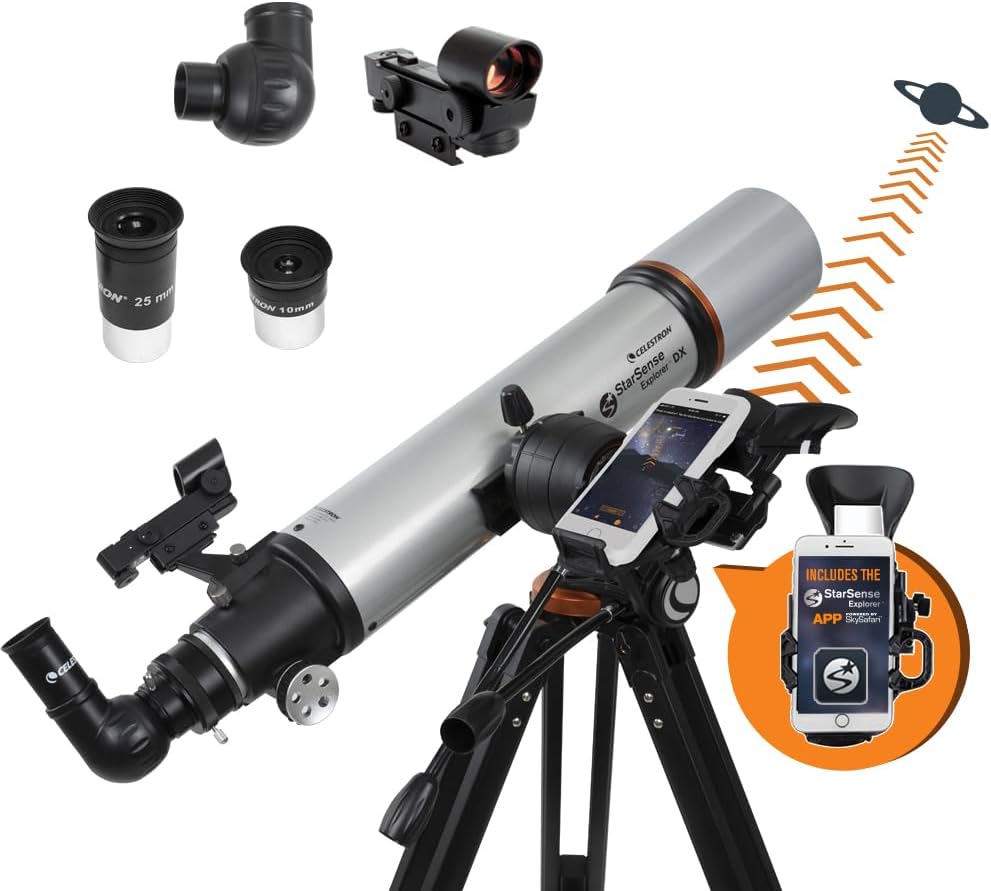
The phone shown illustrates the app; it is not included.
The StarSense Explorer LT 114AZ solves the problem that ends most first telescopes: finding things. A phone sits in the dock on the tube, and Celestron's app matches the star patterns its camera sees to work out where the telescope is pointed. On-screen arrows then guide you to the target you chose. 1
It is also easy to get outside. The mount and tripod come preassembled, the whole kit weighs 10.4 pounds, and it needs no power except the phone. Celestron suggests a power bank to keep the phone charged, which is worth packing on a cold night. 1
The optics are a 114mm reflector with a 1000mm focal length, plus 25mm and 10mm eyepieces giving 40x and 100x and a 2x Barlow lens. Celestron aims it at the Moon, Jupiter and Saturn and at bright deep-sky objects such as the Orion Nebula, and puts its highest useful magnification at 269x. The primary mirror is spherical. 1 8
Check the phone before wrapping it. Celestron says the app works with Android 12 and later and iOS 18 and later, including iPhone XR and newer. The app only works with StarSense Explorer telescopes, because it needs the dock and an unlock code. 1
Best for the Moon and planets
Celestron StarSense Explorer DX 102AZ
A recipient most excited by the Moon and planets who still wants the app to find everything.
The phone shown illustrates the app; it is not included.
The StarSense Explorer DX 102AZ uses the same phone-guided system as the LT 114AZ with a 102mm refractor in place of the mirror. 2 As a refractor, it has no mirror to realign, which makes it the low-fuss choice for the Moon and planets.
Its diagonal gives an erect image, so the view through the eyepiece is right side up and correct left to right. That makes it easier to match the view to the app, and it lets the scope double as a daytime spotting scope. Its 25mm and 10mm eyepieces give 26x and 66x; a Barlow is not included, so a higher-power eyepiece is a sensible add-on for planets. Celestron lists 240x as its highest useful magnification. 2
The mount has dual-axis slow-motion controls, which make it easier to keep a planet centered as it drifts across the view. The mount and tripod come preassembled. At 14.2 pounds for the kit and a 32-inch tube, it is still a one-trip carry to the backyard. 2
The phone requirements and the solar warning match the LT 114AZ. Pay the higher price for this one when the recipient's first question is "can we see Saturn?" rather than "can we find a galaxy?".
Most aperture, no electronics
Sky-Watcher Heritage 150 Tabletop Dobsonian
A patient learner who wants the biggest view for the money and is happy to learn the sky with a star chart.
The Sky-Watcher Heritage 150 puts the largest mirror in this guide, 150mm, on a simple swiveling base. Sky-Watcher says it collects 363 percent more light than the human eye, and a bigger mirror is what makes faint galaxies and nebulae visible at all. Its mirror is parabolic, with a 750mm focal length at f/5, which gives wide views. 3
There are no motors, batteries or apps. You push the tube to the target, and Sky-Watcher fits Teflon bearings for smooth movement and an altitude lock to hold the view. That makes it a good gift for someone who likes learning constellations, and a poor one for someone who wants the telescope to do the finding. 3
Two practical points. The tube collapses for storage, and Sky-Watcher says it keeps its alignment when you do. And it is a tabletop design, so it needs something sturdy to stand on outdoors, such as a patio table, a crate or a stool. Budget for that if the recipient does not already have one. 3
Best computerized scope for an adult
Celestron NexStar 4SE
An adult who wants a motorized telescope that goes to a chosen object and keeps it in view, especially for the Moon and planets.
The NexStar 4SE is the pick when the recipient wants the telescope to find and follow targets. Its computerized mount slews to any of the 38,181 objects in the NexStar+ hand control database and tracks them. Setup uses SkyAlign: center three bright stars or planets, even if you don't know their names, and the mount works out where it is. 4 11
The optics are a compact 102mm Maksutov-Cassegrain with a long 1325mm focal length at f/13. That long focal length suits the Moon, planets and double stars at high magnification, and the tube is only 13.5 inches long. The single included 25mm eyepiece gives 53x; Celestron lists 241x as the highest useful magnification, so an extra eyepiece is worth adding. 4
Plan for power and weight. The mount runs on 8 AA batteries, which are not included, or a 12-volt supply. The whole kit weighs 23 pounds. A built-in wedge supports equatorial alignment for basic astrophotography later. 4 11
Best smart telescope for photos
ZWO Seestar S30 Pro
A photo-minded adult who wants images of nebulae, galaxies and the Milky Way to share, even from a light-polluted backyard.
The Seestar S30 Pro is a different kind of telescope. There is no eyepiece: you choose a target in the app, and the Seestar finds it, tracks it and builds up an image on your phone. ZWO says the app gives access to more than 80,000 deep-sky objects, and its dual-band filter and live stacking are meant to pull nebulae out of suburban skies. 5 6
It is small and self-contained. ZWO lists a 1.65 kg weight, a built-in 6000mAh battery rated for about 6 hours in its lab, and a 30mm apochromatic lens with a separate wide-angle camera for Milky Way and landscape shots. Once the app and firmware are installed, ZWO says it works without an internet connection. 5 6
Know its limits before gifting it. ZWO says planets will appear relatively small and that it is not a dedicated planetary photography system; for Saturn's rings through glass, the DX 102AZ or NexStar 4SE is the better gift. It is sealed, so it cannot take other filters or cameras. Its equatorial mode, which enables longer exposures, needs ZWO's separate TH10 mount. 5
For the Sun, ZWO says a solar filter must be installed and the main camera must never view the Sun directly. ZWO lists a magnetic solar filter as the S30 Pro's external filter; confirm it is in the box, and fit it before any daytime solar session. 5
Frequently Asked Questions
Which telescope is easiest for a beginner to use?
The Celestron StarSense Explorer LT 114AZ. Its app uses a docked phone to find targets and guide you to them, and the mount and tripod come preassembled. It needs a compatible phone: Android 12 or later, or iPhone XR or newer on iOS 18 or later. 1
Is a telescope safe for kids?
With an adult present, yes. Celestron's safety warning says never to look at the Sun through a telescope without a proper solar filter, and to make sure an adult who knows how to use the telescope is with it at all times, especially when children are present. None of the maker pages checked gives an age rating, though the NexStar 4SE's Amazon listing lists its age range as adults. 1 11
Can I look at the Sun with one of these?
Only with a proper solar filter fitted to the front of the telescope. The American Astronomical Society warns that filters which thread into the eyepiece end are dangerous, and that a finderscope must also be capped or filtered. ZWO says the Seestar needs its solar filter installed before viewing the Sun. 7 5
Which telescope shows the most detail on planets?
Do these telescopes need power?
Sources & Methodology
This guide compares five telescopes using their makers' published specifications and safety information, their Amazon listings and the American Astronomical Society's solar-filter guidance, all checked on September 22, 2026. No telescope was tested for this guide. Apertures, focal lengths, magnifications, weights and battery ratings are the makers' figures; fit and target suggestions are editorial judgments based on them. Where a maker's page and its Amazon listing differ, this guide uses the maker's figure.
Prices are Amazon's, checked September 22, 2026: the labeled List price where one was shown, otherwise the current Amazon price. Product photographs are from each product's own Amazon listing; phones shown in them illustrate the apps and are not included. The hero is an editorial illustration of a generic scene, not a photograph of any telescope here.
Celestron: StarSense Explorer LT 114AZ
Maker product page — optics, eyepieces and Barlow, preassembled mount and tripod, kit weight, power, phone compatibility, app scope and the solar and supervision warning.
Celestron: StarSense Explorer DX 102AZ
Maker product page — refractor optics, erect-image diagonal, eyepieces, preassembled mount and tripod, kit weight and solar warning.
Sky-Watcher: Heritage 150 Tabletop Dobsonian
Maker product page — 150mm parabolic mirror, f/5 and 750mm, collapsible tube, tabletop base, bearings and light-gathering comparison.
Celestron: NexStar 4SE
Maker product page — Maksutov-Cassegrain optics, database size, alignment methods, power requirements, included items, kit weight and solar warning.
ZWO Seestar: S30 Pro
Maker product page — planets expectation, sealed design, TH10 requirement for equatorial mode, offline use, solar-filter note.
ZWO: Seestar S30 Pro specifications
Maker specification page — weight, apertures and lens, battery rating, object database and external magnetic solar filter.
American Astronomical Society: solar filters for optics
Solar Filters for Optics — front-mounted filters only, the danger of eyepiece-end filters, and capping the finderscope.
Amazon: Celestron StarSense Explorer LT 114AZ
Selected listing — product photograph and $259.95 List price checked September 22, 2026.
Amazon: Celestron StarSense Explorer DX 102AZ
Selected listing — product photograph and $489.95 List price checked September 22, 2026.
Amazon: Sky-Watcher Heritage 150
Selected listing — product photograph and $355.00 Amazon price checked September 22, 2026.
Amazon: Celestron NexStar 4SE
Selected listing — SkyAlign description, product photograph and $749.00 List price checked September 22, 2026.
Amazon: ZWO Seestar S30 Pro
Selected listing — product photograph and $699.00 Amazon price checked September 22, 2026.
More Guides
 Best Cocktail Machines for Holiday Parties 2026: Bartesian, Barsys and Frozen Drink Picks for Christmas Hosting
 Best Cutting Machines for Christmas Crafts 2026: Cricut, Silhouette and Brother Picks for Cards, Ornaments and Gift Tags
 Best LEGO Christmas and Winter Village Sets 2026: Trains, Houses and Holiday Displays
 Best Photo Printers for Christmas Cards and Photo Gifts 2026: SELPHY, EcoTank, Kodak, instax and PIXMA